








A bulb looks like the simplest part on the bike. Two screws, twist the old one out, push the new one in. Most of the time it is exactly that simple. But two things decide whether the new one does its job: whether it fits, which is about the base and not the brightness, and where its light sits once the lens goes back on, which decides who can see you. Shops talk about the first. Nobody mentions the second.
One bulb, two jobs
On most Indian motorcycles and scooters the rear lamp runs on a single bulb that does two things. Inside the glass there are two separate glowing elements. One is dim and stays on with the ignition, so the bike has a tail light. The other is bright and only comes alive when you squeeze the lever, so the bike has a brake light. Two feed wires, one earth, one bulb.
So when riders ask whether the brake light and the tail light are the same light: they share a lamp, a lens and usually a bulb, but they are two filaments doing two jobs. The lamp has a third job on top of that, lighting the number plate, and we went through all three in our guide to what a bike tail light is actually doing.
What actually fits
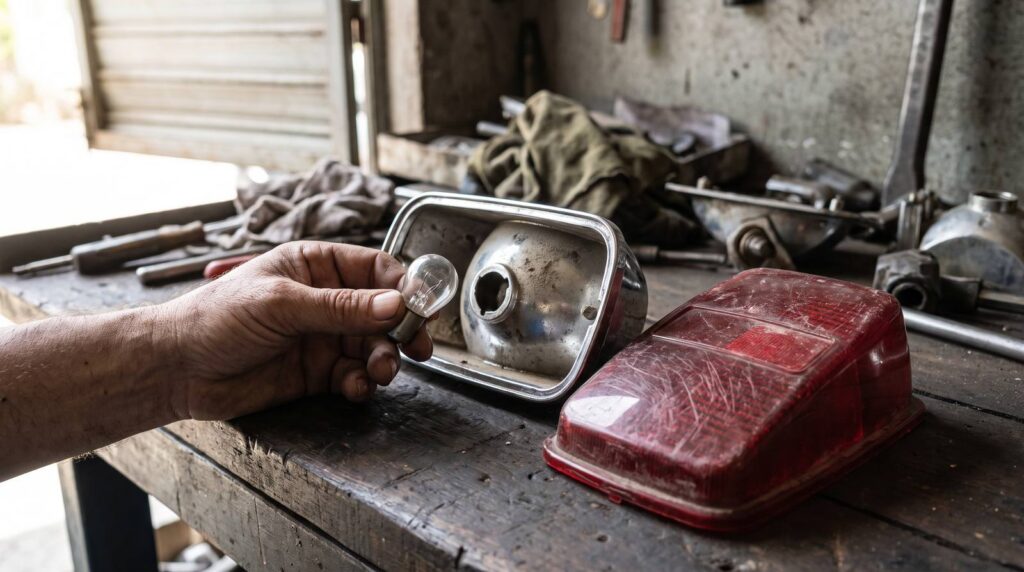
The base decides fitment. A twin element bulb sits in a bayonet holder: push it in, twist, and it locks against two small pins on the side of the metal cap.
Here is the detail that catches people out. On a twin element bulb those two pins are not level with each other. One sits slightly higher, so the bulb can only drop in one way round, and that offset is how the lamp knows which contact feeds the dim element and which feeds the bright one. If a bulb you have just bought goes in happily either way round, or the tail glow now looks fierce and pulling the lever adds nothing, bulb and holder are not the right pair.
The simplest way to buy the right one is to take the old one with you. Undo the lens screws, push the bulb in gently and twist it out, and match what came out at the counter instead of trusting a listing that claims it fits every bike ever made. While the lens is off, look at the two brass contacts in the bottom of the holder and at the earth wire behind the lamp. Dull green contacts and a loose earth kill more brake lights in Indian traffic than dead bulbs do, and both cost nothing to put right.
The part nobody mentions: where the light comes from
A filament is a point of white hot wire glowing in every direction at once. Sit it in a chrome reflector bowl and the whole bowl lights up, the red lens lights up with it, and the lamp reads as one solid red shape from almost anywhere behind you.
An LED board is not a point. It is a flat panel of chips facing one way. Held next to a filament bulb in your hand it can look far fiercer, because all of its output comes straight at you. Bolt it into a reflector designed around a glowing point and two things change. The reflector mostly stops contributing, because nothing is shining sideways into it to bounce back. And the lamp becomes directional.
Directional matters more than it sounds. The car behind you is rarely directly behind you. He is one lane over at the signal, his cab sits higher than your tail lamp, or he is easing out of a side road and sees you at an angle. A lamp that is dazzling at dead centre and thin at twenty degrees off has thrown away exactly the angles where Indian traffic actually sits.
There is a test for this and it takes a minute. Switch the ignition on, stand behind the bike, then walk slowly to one side and then the other, crouching and standing tall as you go. You are not watching for brightness. You are watching whether the whole lens stays lit. If the glow collapses into a hot dot, or the corners go dark as you step aside, that bulb has traded your visibility for a number you can only see from one spot.
What it costs, and the cheaper fix first
A plain twin filament bulb is a few tens of rupees and a few minutes of a mechanic’s time. An LED replacement board for the same holder usually runs to a couple of hundred. A whole rear lamp assembly is a different purchase again, and if yours is cracked or gone milky rather than merely dim, that is the honest route; we looked at what the word universal does and does not promise in our guide to universal tail lights for bikes.
Before any of that, clean the lens, inside and out. Two seasons of fine dust on the inner face of a red lens quietly eats a real part of the light, and removing it costs nothing. Start there and you will know whether you had a bulb problem at all.
Why no bulb fixes the real problem
Everything above happens inside one lamp, in the middle of the bike, roughly the width of your palm. You can make it a better lamp. You cannot make it wide, and you cannot make it move.
Width and movement are what a driver actually reads. Two lights set apart tell him how far away you are and how fast he is closing, because his eyes judge distance from the gap between them. One red dot in the centre tells him very little, and movement cuts through the filtering a tired driver does after an hour of identical red lamps ahead of him.
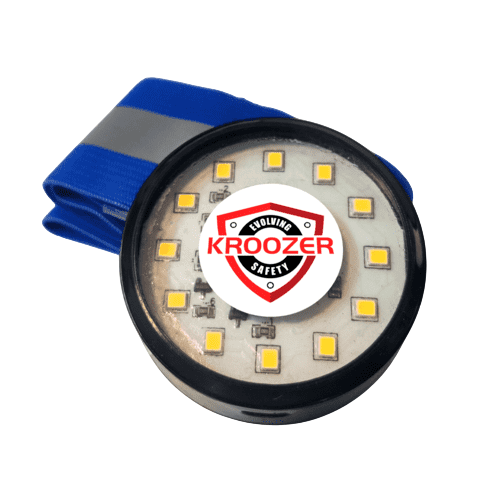
That is the reason the KROOZER Strobe Light for Bike V7.0 Pro with Brake Mode is supplied as a pair rather than as one light. One pod goes on each side of the tail, roughly 40 cm apart, on a bolt-on L bracket with no drilling needed. Most riders have the kit on in 15 to 20 minutes. A push-button switch runs 20+ selectable patterns, and Brake Mode wires into the brake circuit so both pods fire the moment you touch the lever, alongside whatever pattern you are running.
One honest limit, because it belongs on this page. Brake Mode shares the brake circuit with your brake lamp, so like your brake lamp it says nothing when you slow on a closed throttle without touching the lever. That gap is the subject of our guide to how long a brake signal actually lasts; the pattern running the rest of the time is what keeps you readable in between.
The pods are anodised aluminium in a sealed, weather resistant housing, fitment is universal across motorcycles, and the kit is ₹1,399 for the pair, made in India, with a one year warranty. Shipping is free across India above ₹1,000, and international orders can check out with the cost quoted after the order. The rest of the range sits in our strobe light collection.
One thing to keep in mind as you add anything at the back. Auxiliary visibility lights are treated differently from state to state, and how a light is used matters as much as the light itself. Check your local RTO guidance and ride considerately. The point is to be seen, not to dazzle the rider behind you.
What to do, in order
- Clean the lens, inside and out. Free, and often the biggest single gain.
- Check the two contacts in the holder and the earth wire before you blame the bulb.
- Take the old bulb to the shop and match the base, not the brightness.
- If you fit an LED board, do the walk-around test before the screws go back in.
- If you want to change how drivers read you, add width and movement rather than more brightness in the same spot.


