








Scroll any bike accessories listing in India and the same word keeps turning up. Universal. Universal tail light for bike. Fits all models. Rs 275, free delivery, pack of one.
It reads like a promise that nothing can go wrong. What it actually promises is one bolt.
Three things have to match. Only one of them is universal
Replacing a rear lamp means matching three separate things to your bike. The listing answers the first one and goes quiet about the other two.
The mount. This is what the word refers to. Most of these units hang off the number plate bracket or sit on a pair of slotted holes, and slots mean the bolt spacing can be nudged until it lines up. That part genuinely does fit most bikes.
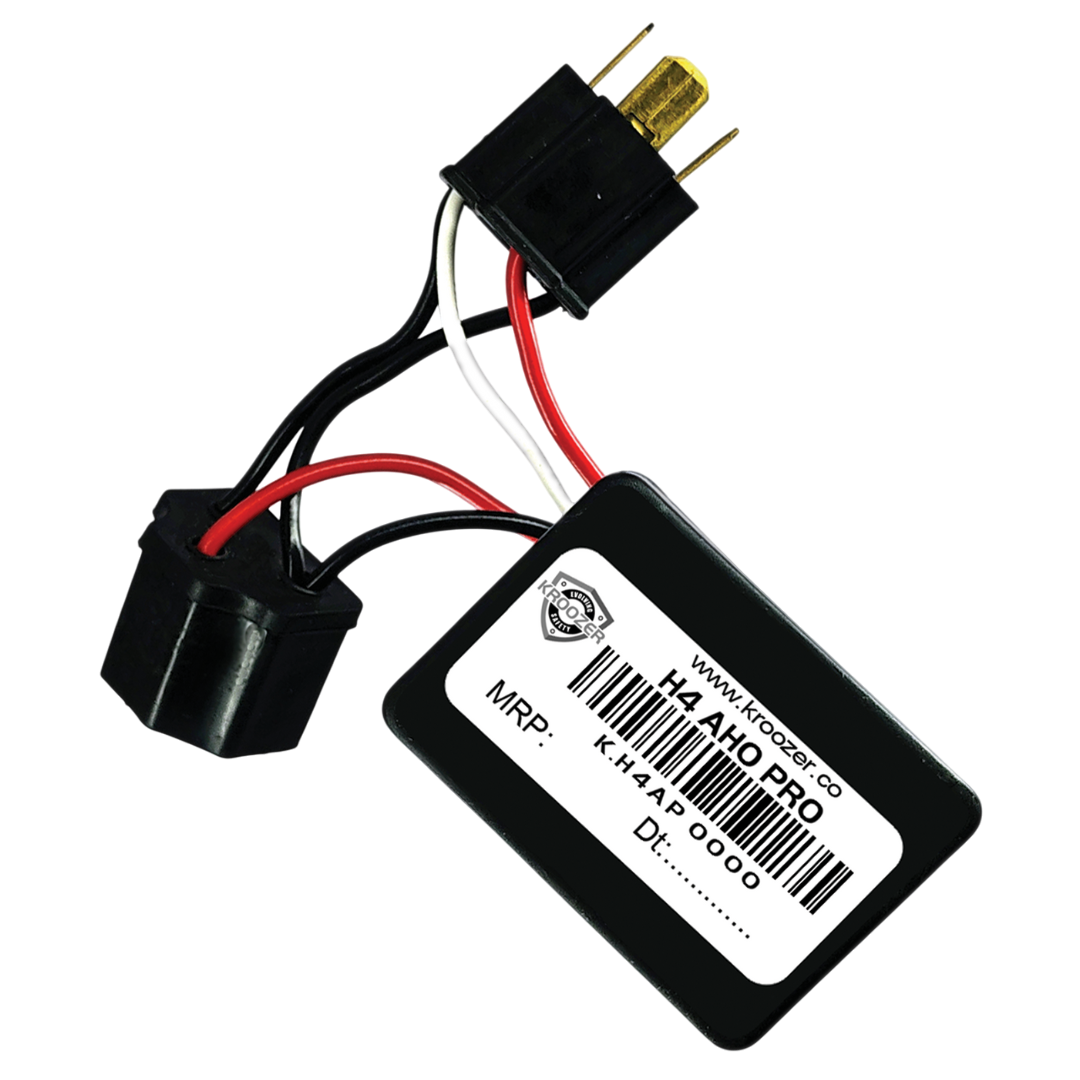
The wiring. Not universal. Your rear loom ends in a connector the factory chose. A universal lamp ends in bare leads, usually three of them: running light, brake, earth. Five if the blinkers are built in. Nothing plugs into anything. Somebody is going to cut, join and tape, and that somebody wants to know which lead is which before the parcel arrives, not while standing over an opened tail panel at nine at night.
The job list. Also not universal, and this is the one that quietly costs you something. Your factory rear assembly is doing more than you think. We wrote about that in detail in our guide to what a bike tail light is actually for: it carries the running level, the brake step up, and on most Indian bikes a small lamp pointed at the number plate. There is usually a reflex reflector in there too, moulded into the lens or clipped behind it.
That reflector is worth pausing on. It is the only thing at the back of your bike that works when your electrics are dead. Flat battery, blown fuse, cut wire, bike parked on the roadside with everything switched off, and the reflector still throws a driver’s headlight back at him. Swap in a slim aftermarket bar that drops the reflector and the plate lamp, and you have not just changed the look. You have removed the one rear signal that never needed power in the first place.
The all-in-one unit concentrates your message
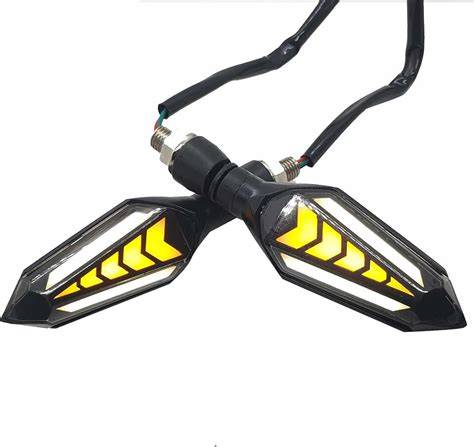
The popular shape right now is the integrated unit. Tail, brake and both indicators in one housing, one neat strip across the back. It looks tidy. It is also doing something to how your bike reads from behind, and it is worth understanding before you buy.
The back of a motorcycle communicates with two things, not one. Light, and where that light is.
Running versus brake is a change in level from the same place. Same lamp, brighter. A turn signal works differently. It works because it is offset, sitting out to one side, and the side it sits on is the message. The blink is what catches your eye. The offset is what tells the driver which way you are about to go.
Pull both blinkers into the tail lamp housing and that offset shrinks from most of the width of the bike down to a few inches. Up close, fine. At the distance where a driver is actually deciding whether to overtake you or wait, a few inches of separation is not much to read. You keep the blink and you give up the geometry. For more on what that one lamp is promising, there is our guide to the indicator as a statement about what you are about to do.
None of which makes an integrated lamp a bad buy. Plenty of riders fit one and are happy. Just know that you are buying a cleaner tail end, not a louder one.
An animation is a sequence. A brake light should not be
Many of these units advertise an animated park light effect, a sweep or a chase that runs across the strip when you switch on.
An animation unfolds over time. That is what makes it an animation. For a welcome flourish on the running light, there is no harm in it.
A brake light has the opposite job. Its entire value is that it changes state at once, the instant your fingers close. Anything that makes that arrival gradual is working against the one message back there that is time critical. So if you are looking at an animated unit, find out whether the brake function comes on instantly and independently, or whether it is tangled into the same effect. Ask the seller plainly. If nobody can answer, that tells you something too.
What to check before you order
Four questions. All of them answerable in five minutes, and all of them cheaper to ask now than on a Sunday with the panel off.
- What is my loom actually carrying? Find out how many leads your rear lamp uses and what each one does. Your bike’s own manual or a mechanic who knows the model will tell you in thirty seconds.
- Does it light the number plate? If your current assembly does that job and the replacement does not, you need to solve it separately rather than discover it later.
- Is there still a reflector back there? Either in the new unit or added on its own. Do not end up with nothing passive at the rear.
- Is the brake instant? Separate from any animation, not part of it.
And one more, less technical: are you replacing this lamp because it failed, or because you want to be seen better? Those are two different purchases, and the second one is not best solved at the back of the bike in a single housing.
Adding, rather than replacing
If being seen is the real goal, concentrating everything into one tidy strip is the wrong direction. The useful move is the opposite one. Leave the factory lamp doing its proper job and add a second signal somewhere else on the bike, with its own rhythm and its own position.
That is the thinking behind the KROOZER Strobe Light for Bike V7.0 Pro with Brake Mode. It comes as a pair at Rs 1,399, one pod per side, roughly 40 cm apart on bolt-on L brackets, no drilling needed. Twenty selectable patterns on a push button switch, anodised aluminium bodies, and Brake Mode wires into your brake light so the pods fire when you brake as well. Fitting takes most riders fifteen to twenty minutes, and it is universal: it goes on any motorcycle. Made in India, one year warranty, free shipping across India on orders above Rs 1,000. International orders are quoted after you place them and confirmed before dispatch. The rest of the range sits in our strobe light collection.
Your tail lamp keeps saying its one sentence. The pods say a different one, from a different place, in a different rhythm. Two signals from two positions is harder to miss than one signal made prettier.
One note on the rules
Kroozer strobes are auxiliary visibility lights. Rules on auxiliary lighting and on modifying factory lighting vary by state and by how a light is used, so check your local RTO guidance and ride considerately. Anything that changes or obscures the lamp over your number plate is worth being especially careful about. The point of all of this is to be seen, not to dazzle anybody.
Universal, in the end, is a word about a bracket. Everything else on that listing is your homework.


