








Search for a blind spot mirror for a bike in India and you get two unrelated products in one results page. One is a small convex disc that clamps to a bicycle handlebar. The other is a round add-on mirror for a motorcycle, stuck or bolted onto the face of your existing mirror or out at the bar end. Same search, often the same photographs, two different bikes.
This is about the motorcycle one, and it makes an argument no listing on that page will make: the mirror works. It just works on the wrong blind spot.
What the convex disc actually does
A flat mirror hands you a narrow slice of the road behind, in true proportion. Curve the glass outward and it gathers a much wider slice, because every part of the surface is aimed somewhere slightly different. You see more. On a commuter bike with small stock mirrors that is a real gain, not a marketing one.
What you pay for it is proportion. Everything in a convex mirror looks smaller and further away than it is, and the nearer an object comes, the faster it grows. A car that reads as a comfortable gap in a convex mirror can be much closer than your eye is reporting. Most riders need a few weeks of regular use before the instinct recalibrates. Until then the mirror gives you more information and slightly worse judgement, which is worth knowing before you fit one.
Where to put it
The stock answer, repeated on every listing, is the upper outer corner of your existing mirror. That is a car answer: on a car the uncovered region sits out past the rear quarter, so you aim the extra glass outward and down.
A motorcycle’s problem is different, and it is sitting on the bike with you. Your own shoulder, upper arm and elbow block a wedge of what the mirror could otherwise show, and that wedge moves every time you shift your weight or tuck in.
Riders meet it the first time they check a mirror mid corner and find their own jacket there. So the useful placement is not a rule, it is a test. Sit on the bike in your riding position, in the jacket you actually wear, and have someone walk a scooter slowly up your right side from behind. Note where they vanish from the mirror and when they reappear in the corner of your eye. Mount the disc to fill that gap, and accept that you may need it inboard and high rather than outboard, because on a bike the obstruction is you.
Now the blind spot that actually hurts
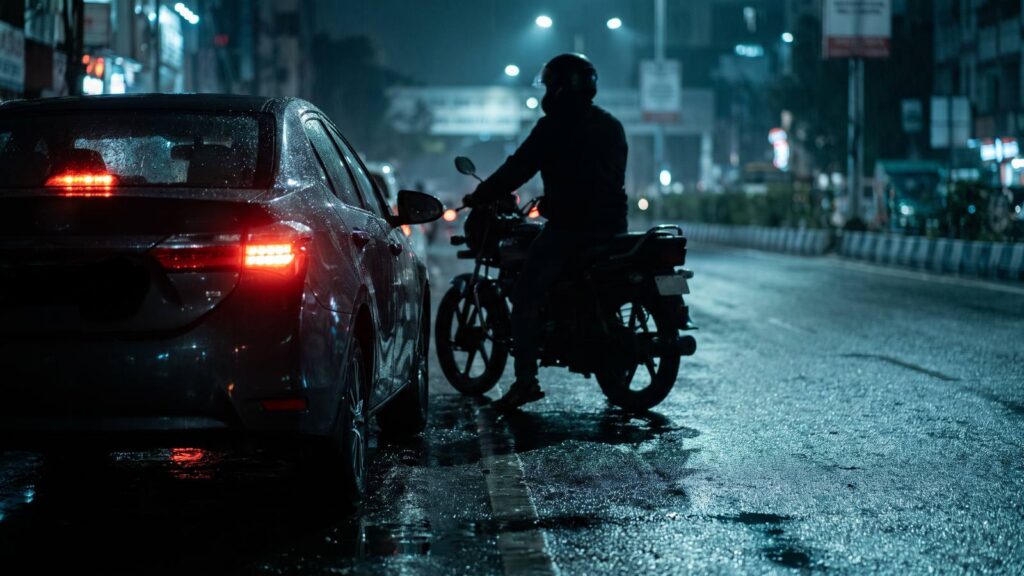
Here is where the category quietly changes subject. Think about the collisions riders in India actually fear. A car drifting into your lane on a flyover. A sedan turning right across your line. A truck pulling out of a service road. In almost none of them did the rider fail to see the other vehicle. He saw it coming and had nowhere to go. The failure was on the other side of the glass.
That driver has a blind spot too, and it is a much more dangerous one, because a motorcycle fits inside it completely. A car is wide enough that some part of it always shows in a door mirror or at the edge of the windscreen. A motorcycle is roughly the width of its rider. There is a region beside and slightly behind a car’s rear quarter that neither mirror nor direct vision covers, and a bike can sit in it for a whole overtake without ever existing, as far as that driver is concerned.
Nothing you bolt to your own handlebar reaches inside his car. You cannot adjust his mirror and you cannot make him turn his head. That is the hard limit of every mirror purchase: it improves what you see and changes nothing about what he sees.
What you can change is what arrives in his mirror
A mirror glance is short. In that fraction of a second the driver is not identifying objects and reading the scene. He is sampling for change. Anything that holds still gets filed as background, which is exactly what a single steady lamp behind him becomes after the first glance. It is also why a bike with one tail light can read as a scooter, a cycle or a distant car all at once, with nothing to separate them.
Two things break through a glance like that. One is change, because peripheral vision is built to notice it and little else. The other is width, because a pair of separated points lets him measure how fast the gap between them grows, which is how closing speed is actually judged. One lamp carries no width at all. That argument is worked through properly in our piece on side lights and the angle your lamps do not cover, so it is not repeated here.
Five ways the add-on mirror disappoints
- Vibration. Bar ends shake, and a small convex surface magnifies that shake into blur at exactly the engine speeds you cruise at.
- It eats the glass you were using. Stuck on the stock mirror face, it covers the part you had already learned to read.
- Adhesive and Indian summers. Pad-mounted discs on a black mirror shell in May are the most common way these end up on the road behind you.
- Width in traffic. An outboard disc adds width on each side, which matters when you are filtering between an auto and a bus.
- It invites the long look. More to see means more time looking back, and that time comes out of the road ahead. In city traffic that is a poor exchange.
Where a mirror does earn its place
Buy one if your stock mirrors are genuinely narrow, and most Indian commuters are. On a highway, deciding whether to pull out around a line of trucks, a wider rearward view is worth far more than it costs. Same for long rides where you are tracking a riding partner behind you.
Just buy it for what it is. It tells you more. It does not announce you.
The other half of the problem
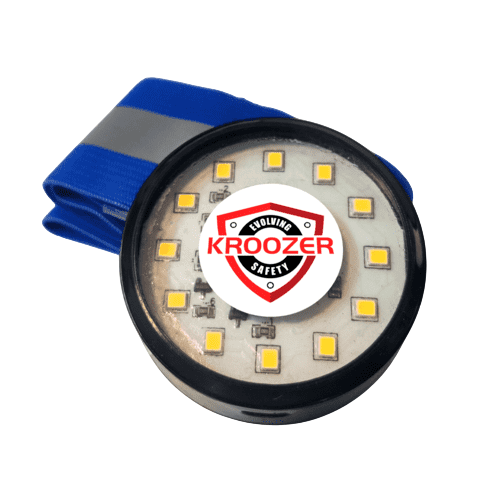
Being announced is a separate purchase, and it works on the driver rather than on you. The KROOZER Strobe Light for Bike V7.0 Pro with Brake Mode is a pair of sealed anodised aluminium pods, one per side, mounted about 40 cm apart so there is real width between them. They give him change where he was getting a steady point, and two separated sources where he had one. There are exactly 20 selectable modes, including an Always-On steady setting for when you want presence without flash. Brake Mode wires into the brake light, so braking takes over with a hyperflash while the patterns stay available the rest of the time.
It bolts on with an L-bracket, no drilling, about 15 to 20 minutes, with a push-button switch on the bar. Waterproof, universal fitment, supplied as a pair at Rs 1,399 with a one-year warranty, made in India, free shipping across India on orders above Rs 1,000. The rest of the range sits in strobe lights.
One caution, said plainly. These are auxiliary visibility lights. Rules vary by state and by how a light is used, so check your local RTO guidance and ride considerately. The point is to be seen, not to dazzle the person you are warning. For the wider argument about being noticed rather than merely lit, start with how to be more visible on your bike and what an indicator actually promises.
A blind spot mirror changes what you can see. It cannot change what he sees. Those are two different purchases, and only one of them is about you.


