







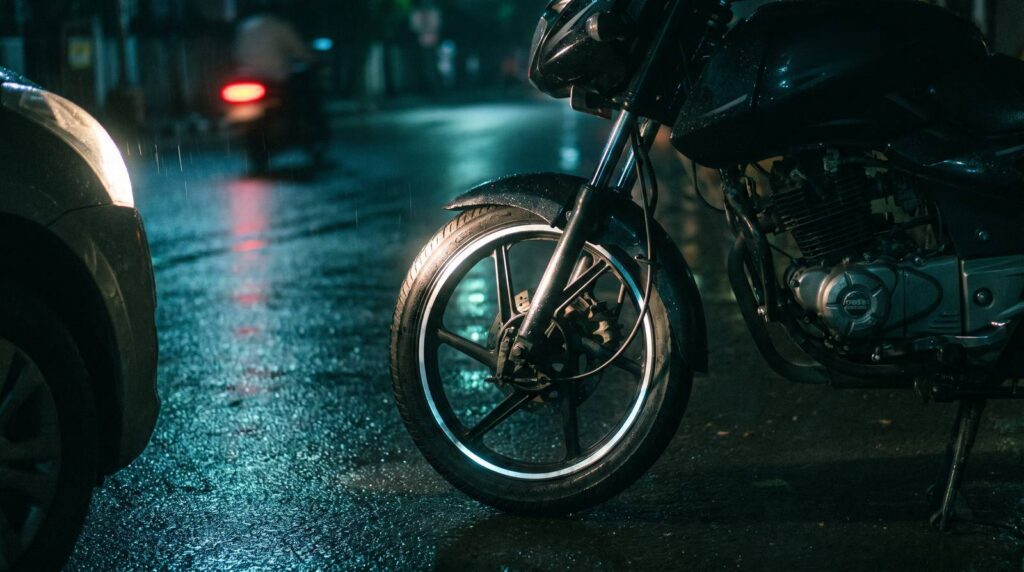
A reflective sticker is one of the cheapest things you can put on a motorcycle, and one of the most misunderstood. Search for one and you get twenty-piece rim kits for a hundred rupees, honeycomb patches, glow strips, and a lot of confident promises about how far away you will be seen.
Almost none of it explains the thing that decides whether the sticker does anything at all. A reflective sticker makes no light. It borrows somebody else’s.
What the film is actually doing
Ordinary paint scatters light in every direction, so a little reaches everybody and not much reaches anybody. Retroreflective film does something stranger. Its surface is packed with tiny glass beads, or with moulded corner prisms, and both do the same job: light goes in, bounces around inside, and comes back out almost exactly along the path it arrived on.
That is why reflective tape looks dazzling in a flash photograph and looks like dull grey plastic in your hand. The light is going back to wherever it came from. So a reflective sticker is never simply visible. It is visible to one person: whoever’s headlight is currently lighting it.
Three conditions, and they all have to be true together
For the film to earn its place, somebody has to be shining a light at you, that light has to land on the sticker, and their eyes have to sit close enough to the beam to catch the return.
Car drivers tick all three nicely. Headlights sit low, the driver sits just above them, and the return comes straight back into the windscreen. A truck driver sits high above his lamps, which is part of the reason he can miss what a car driver picks up easily. And anyone on dipped beam in a lit city lane is pointing light down and short, so a sticker up on your tail panel can sit outside the beam completely while one low on the fork leg is lit the whole time.
Which gives the one placement rule nobody on the first page of results bothers to state: put the film low and wide, not high and central. Fork lowers, the bottom edge of the tail panel, the swingarm, the outer faces of a pannier or top box, the rims. The pretty placements high on the bodywork are the ones that spend most of their life in the dark.
Rim tape is better than the sellers realise
Rim strips dominate every listing and are almost always sold as decoration. They are the best value reflective thing you can put on a bike, for a reason that has nothing to do with brightness.
A lit patch on your tail tells a driver that something is there. A lit ring on a turning wheel tells him considerably more: that it has two wheels, roughly how fast it is travelling, and that it is moving rather than parked at the kerb. Shape and movement are what a tired driver reads in the half second he gives you, and a rotating circle of light is the only thing on a motorcycle that hands him both at once. If you are buying one reflective item, buy rim strips, and run them on both wheels so you read the same from either side.
The trap: glow is not reflective
Two completely different products share the same shelf, and sometimes the same listing.
Retroreflective film returns light that hits it, for as long as the film is clean and intact, and does nothing on its own in a pitch dark garage.
Photoluminescent film, the glow in the dark sort, charges up in daylight and then gives off a faint green light of its own, fading the whole time. An hour into a night ride it has given up. It looks magical on a shop counter and it is close to useless on a road.
If a listing leans on the words glow, night glow or luminous and never says reflective or retroreflective, assume it charges rather than reflects. There is an easy test in a shop: ask them to shine a phone torch at it from across the room. Retroreflective film lights up hard and bright from exactly where you are standing. Glow film barely changes.
Getting it to stay on
Reflective film fails at the edges, and almost always because of what was under it.
Wash the panel, dry it properly, then wipe it with isopropyl alcohol and let it flash off. Polish and wax are the real enemy, because a waxed tank feels clean and will not hold adhesive. Warm the film and the panel slightly on a cold morning so the glue goes tacky rather than stiff. Press from the middle outwards and run a thumbnail along every edge, since a lifted edge is where water starts the peel.
Pre-cut rim strips are the one place people go wrong. They are curved for a reason. If you find yourself stretching a strip to make it meet, it is the wrong size for your rim, and the stretched section will lift first. Keep film away from the exhaust, keep the pressure washer lance off the edges, and expect a strip near the chain to need a wipe.
What a sticker cannot do
This is the honest limit, and the reason Kroozer builds lights rather than stickers.
Reflection is conditional. It waits to be found. No headlight on you means nothing on your bike is lit, and that covers a lot of real riding: dusk, rain with spray flattening every contrast, a street-lit market lane where everyone is running dipped beams, and the most ordinary near miss in the country, a car easing out of a side road with its beam pointed across you instead of at you. In all of those, the film on your swingarm is simply dark.
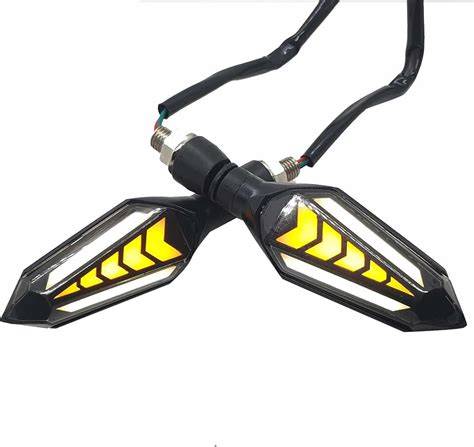
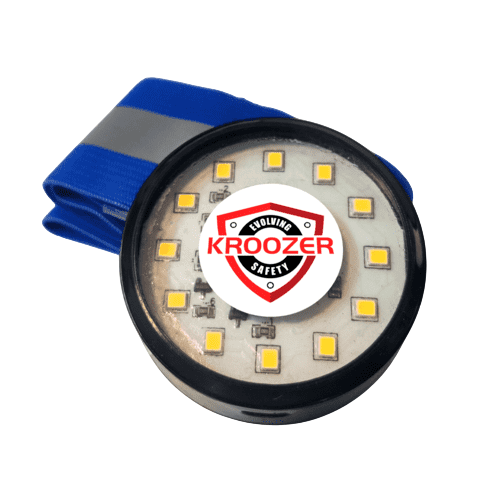
An active light does not wait. The KROOZER Strobe Light for Bike – V7.0 Pro with Brake Mode makes its own light, so it works whether or not anybody is pointing a beam at you. It comes as a pair, one pod per side, roughly 40 cm apart on bolt-on L brackets with no drilling, and most riders have it fitted in 15 to 20 minutes. There are 20 selectable modes, including a steady Always-On setting for riders who would rather not flash, and Brake Mode wires into the brake light so the pods fire when you brake as well as running their pattern. The housings are sealed anodised aluminium and waterproof, the fitment is universal, it is made in India at Rs 1,399 with a 1 year warranty, and shipping is free across India on orders above Rs 1,000. You can see the rest of the range in our strobe lights for motorcycles.
Worth saying plainly: Kroozer strobes are auxiliary visibility lights. Rules vary by state and by how a light is used, so check your local RTO guidance and ride considerately. The point is to be seen, not to dazzle the person behind you.
Where to spend first
- Rim strips on both wheels. Cheapest, and the only thing that reads as shape and speed.
- Film low on the fork lowers, swingarm and the bottom edge of the tail, where dipped beams actually point.
- Something on the rider as well as the bike, since you are the tallest part of the package. Reflective bands and reflective patches for a riding jacket both sit above the bodywork.
- An active light, once the passive layer is done, because that is the part that works when nobody is looking for you yet.
Stickers are a good first rupee spent. Just buy them knowing what they are: a mirror that needs somebody else to switch it on. For the wider picture, see how to be more visible on your bike at night and in the rain.


