







Search for a laser light for a bike in India and you get two products with almost nothing in common. One is a small pod that throws a red line onto the tarmac behind you, an idea borrowed from bicycles and sold here as a virtual lane. The other is an ordinary spot lamp with the word laser on the box and no laser inside it.
Riders buy both for the same reason. They are tired of cars arriving in their boot. Fair thing to want. Worth knowing what a projected line actually does first.
Two products, one word
The rear projector is the honest version. A diode draws a bright line on the road a bike length or so behind you, the thought being that a driver reads it as a boundary and keeps out.
The second kind borrows the word because laser sells. Hold one next to any cheap auxiliary lamp and you are looking at the same part. If the listing offers it in several colours with a wide beam, there is no laser in it.
The confusion is not yours alone. Google’s own answer on this search ends by asking which of the two you meant, which tells you how little explaining anybody has bothered to do.
What a driver is actually doing when he looks at you
A driver closing on you from behind is not measuring brightness. He is solving two problems at once, mostly without noticing: where is that bike, and is the gap shrinking fast or slow.
He answers both from points of light fixed to your machine. Two points with a gap between them read as a width, and that width grows as he closes. Crude rangefinder, and it works. A single point tells him less, but it still says where you are.
A line painted on the road by a laser is attached to the road, not to your bike. It sits wherever the lens was aimed. It stays that same size whether the car is far back or nearly touching you, so it carries no closing-speed information at all. It marks a boundary. It never says this is where the rider is.
The line lands in the one place he cannot see
From a car seat the strip of road just beyond the bonnet is the part a driver sees least, and in an SUV it is hidden outright. A projected line sits exactly there once the gap closes. Readable from well back, when nothing was going to happen anyway. Gone at the moment it was meant to matter.
It fades in the conditions you bought it for
A laser line looks dramatic in a dark basement parking. On a real road it competes for contrast and loses more often than the listing suggests. Wet tarmac smears it. Coarse chip seal breaks it up. Street lighting makes it faint. Worst of all, the headlights of the very car you are warning point at the same patch of road, so the brighter his lamps, the weaker your line. In daylight it does not exist at all. Our piece on what the strongest bike light really means has the longer version of why raw output stops helping.
Laser fog light is a contradiction
Fog works by scattering light back at you. Lamps that genuinely help in fog sit low and spread wide, throwing light under the fog bank rather than into it. A tight collimated beam is the worst possible shape for that job: it lights the fog itself and blinds you a little doing it. The two words on the box pull in opposite directions, and most products wearing them are LED spot lamps with a sticker.
Colour is the third problem
Road colour carries meaning and riders lose by ignoring it. White reads as the front of a vehicle, red as the back of one. Green and purple behind you carry no agreed meaning on an Indian road, and blue carries a borrowed one nobody wants attached to their bike. A green line is something a driver has to stop and decode, and at speed nobody decodes anything.
Five things the listing will not mention
Aim is everything. A few degrees out and the line lands too close, too far or on the kerb, and vibration walks it over a few weeks of Indian roads without anybody noticing.
A dirty lens kills a narrow beam. A diffuse LED picking up grit and road film just gets dimmer. A collimated beam scatters into nothing, and the rear of a bike is the dirtiest place to mount anything.
The wiring decides what it means. Cheap kits tap whatever live wire is easiest to reach. The parking feed leaves it glowing with the ignition off. The indicator feed makes it flash with your turn signal, which is worse than nothing.
Eye level. A rear projector sits low and is usually fine. A front-facing one aimed by hand puts a narrow beam at the face of whoever is coming the other way, and a dazzled driver is a problem you made.
One more box to keep sealed. Anything with a driver module and a connector behind your tail lamp is another thing that water finds first.
Where a projected line genuinely earns its keep
Parked. Broken down on a highway shoulder at night, waiting for help, is exactly where a hard line on the tarmac behind you does real work. It is a warning triangle made of light, and nobody needs a closing speed off it because you are not going anywhere. Worth carrying for that alone.
The glow strips riders fit under the engine fail in a related way, covered in why underglow lights the road rather than you. Underglow gives a driver no edges at all. A laser gives him one in the wrong place.
If the goal is being seen, buy width and change
Two things move a driver’s eye: separation and change. A gap between two sources reads as a width and opens as he closes, which is the measurement he needs. Change buys a second glance a steady lamp never gets. Our piece on what a DRL adds when your headlight is already on works through both in daylight.
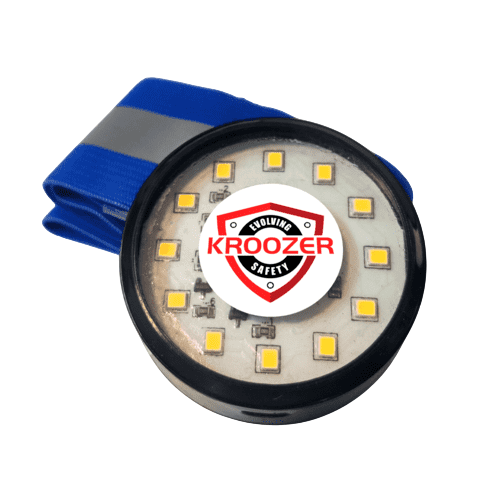
That is the shape the KROOZER Strobe Light for Bike V7.0 Pro with Brake Mode is built around. It comes as a pair, one pod per side, about 40 cm apart on bolt-on L brackets, so the separation is built in and nothing gets drilled. Twenty selectable modes, including a steady Always-On setting for riders who want presence without flash, and Brake Mode wires into the brake light so the pods fire when you brake. The housing is sealed anodised aluminium and waterproof, which matters more at the back of a bike than anything printed on a box. Fitment is universal, and most riders have it on in fifteen to twenty minutes with a push-button switch on the bar. 1,399 rupees, one year warranty, made in India, and free shipping across India on orders above 1,000 rupees. The rest sits in our strobe lights.
Questions riders ask
Does a laser line make me more visible? It makes a patch of road more visible. Not the same thing. A driver judging where you are and how fast he is closing gets neither from it.
What about the rules? Kroozer strobes are auxiliary visibility lights. Rules on auxiliary lighting vary by state and by how the light is used, so check your local RTO guidance and ride considerately. The point is to be seen, not to dazzle anybody.
So is it a waste of money? Not as a marker for a parked or stranded bike. It is the wrong tool for making traffic read your position while you are moving, which is what most riders are buying it for.
Be seen early, and give the driver behind you something he can measure.


