








Ask this in any rider group and you will get numbers back within a minute. Someone will quote a lumen figure off a box. Someone else will say his bar throws further. A third will quietly say bhai, mera sabse bright hai, and that is usually the end of the discussion.
We make lights for a living, so here is the unglamorous version. Strongest is not really a property a bike light has. It is a number somebody chose to print, measured in a way nobody published, describing an output that changes the moment the light is bolted to your bike. You can buy the biggest number on the page and still be the rider nobody sees at the junction.
That is worth unpacking, because it is the most expensive assumption in this category.
Nobody agrees on what they are counting
A lumen figure can be measured at the LED chip, before the light has passed through a lens, a reflector or a tinted cover. It can be measured coming out of the finished housing, which is always a smaller number. It can be the peak the light hits for a few seconds on a cold bench, or the output it settles at once it warms up. All four are defensible. All four give you a different figure for the same light.
Sellers who want to look good quote the first. Sellers being careful quote the third. Nothing on a listing tells you which you are reading. So when you compare one brand’s number against another’s, you are usually not comparing two lights. You are comparing two marketing departments.
This is the same problem the price gap has, and for the same reason. We wrote about where the money actually goes in a bike light if you want the cost side of it.
The number says nothing about where the light goes
Take one emitter and put it behind a narrow lens. You get a tight, far-reaching spot. Take the identical emitter and put it behind a wide diffuser. You get a broad, soft wash that reaches nowhere in particular. Same output, same figure on the box, two completely different products for two completely different jobs.
Beam shape is the specification that decides whether a light works for you, and it is the one almost nobody prints. A rear-facing pod needs to be readable from directly behind you and from the side, because the car that hurts you is often the one turning across your lane rather than the one following it. A forward auxiliary lamp needs its light on the tarmac and off the face of the man coming the other way. We went through that in detail in the piece on what the fog lamp rules actually turn on, and aim does more work there than output ever does.
Bright is always bright compared to something
Here is the part that gets missed. Your light is not competing against darkness. It is competing against whatever else is in the driver’s windscreen at that moment.
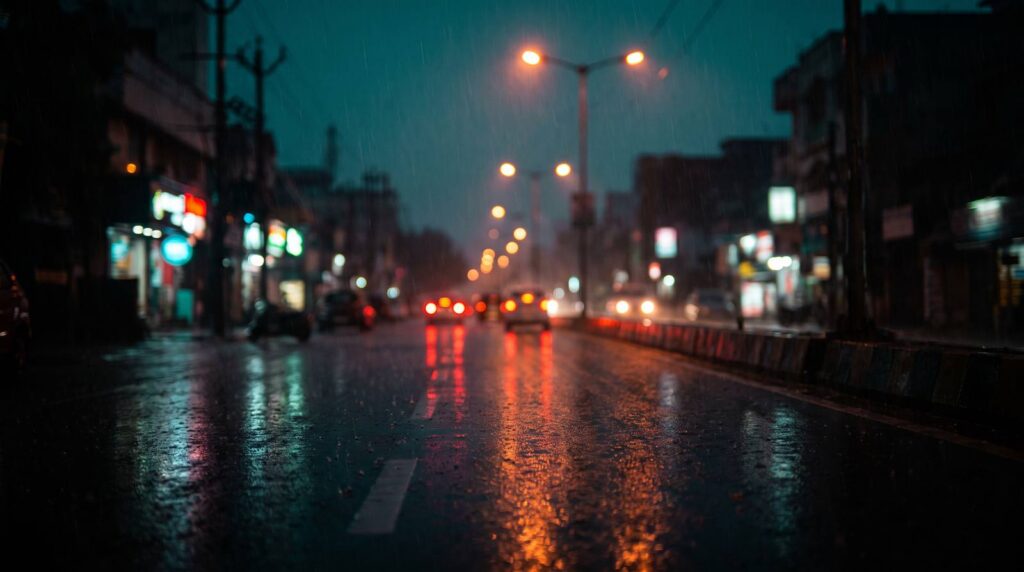
On an empty stretch of highway at 2am, a modest rear light is enormous. There is nothing else there. Put the same light on Ring Road at 8pm, behind a row of tail lamps, under sodium street lighting, next to a shop hoarding with its own LEDs, and it becomes one more red dot in a field of red dots. Nothing about the light changed. The background did.
Chasing output is an attempt to win that contest by being louder than everything else in the frame. In a city, at night, in India, you will not win it. There is always a brighter hoarding. The lights that survive that environment do it by being different from the background rather than bigger than it, which is a different engineering problem with a different answer.
Where extra output starts costing you
Past a certain point, more brightness stops buying attention and starts buying irritation.
A driver who catches a harsh light square in the eyes does not study it. He squints, tilts his head, and looks somewhere else, usually at the patch of road just in front of his bonnet. You have taken his attention off you at exactly the moment you wanted it. Worse, you have taken away his ability to judge how far away you are, because a light that has bloomed into a white smear has no edges to measure against.
There is a social cost too. Every rider who dazzles the traffic behind him makes the next rider’s auxiliary lights slightly less welcome. Kroozer strobes are auxiliary visibility lights, the rules on auxiliary lighting vary by state and by how the light is used, so check your local RTO guidance and ride considerately. The point is to be seen, not to dazzle.
What actually decides whether you register
Three things do more work than output, and none of them appear as a number on a listing.
Position comes first. A light mounted where a driver’s eyes already go, at the corners of the vehicle rather than the middle, is read as part of a vehicle rather than as a stray reflection. Separation comes second. Two points of light with space between them give the driver a width to judge, and width is what tells him he is looking at something he has to go around rather than a spark on the road. We covered that in the guide on choosing between strobe types.
Change comes third, and it is the one people underestimate most. A light that alters over time cuts through a static background in a way that a steady light of any size does not. That is a longer argument than it looks, and we made it properly in the piece on whether flashing lights actually help, including the situations where a flash works against you.
Better questions than how strong is it
When you are standing in a shop or scrolling a listing, swap the question. Where does this light sit on the bike, and is that a place drivers already look. Is it doing something the background is not already doing. Can you switch it off in slow traffic when it stops helping. Will it still be sealed after two monsoons, and does anyone stand behind it if it is not.
Those questions have answers you can check. The brightness number, in this market, mostly does not.
Quick answers
Is a brighter rear light always safer? No. Up to a point it helps. Past that point it costs you the driver’s attention and his ability to judge distance.
Can I compare lumens across two brands? Not reliably, unless both state where and how they measured. Most do not.
What should I look at instead? Where it mounts, how wide it reads from behind and from the side, whether it changes over time, and how it is built.
The kit this article is about
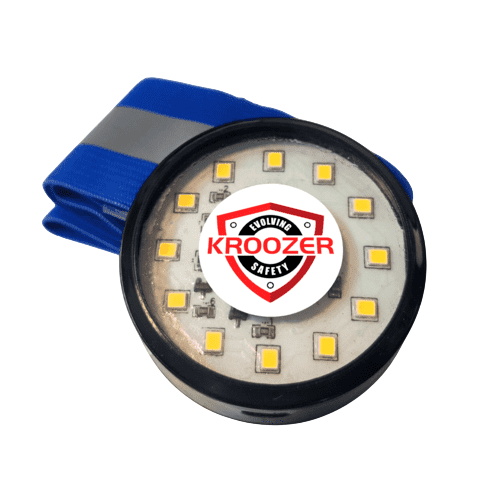
The KROOZER Strobe V7.0 Pro with Brake Mode is built around the second half of this argument rather than the first. It is supplied as a pair, one pod on each side of the tail, so the driver behind you gets two points and a width instead of one dot. It carries 20 selectable patterns on a push-button switch, and Brake Mode wires into your brake light so the pods fire when you brake. Bolt-on L-brackets, no drilling, 15 to 20 minutes with basic tools, and it fits any motorcycle. Anodised aluminium, sealed housing, made in India. Rs 1,399, one year warranty, free shipping across India on orders over Rs 1,000. For international orders, place the order as usual and we will quote the shipping cost and confirm it with you before dispatch.
You can see the rest of the range on the strobe lights page.


