








If you are shopping for a white strobe light for your bike, it is worth stopping on one question before you spend anything. Not “which one is brightest,” but “which colour will a driver actually understand.” Being seen is only half the job. The other half is being read correctly, in the half second a tired driver has to react to you.
Colour is how that reading happens. So here is what each colour says on the road, and where a white strobe really belongs, before you pick one.
A flashing light is a message, and colour is the language
Every light on the road already means something, and drivers learn it long before they could ever explain it. White light lives at the front of a vehicle. It says “this is the front of something, and it is pointing at you.” Red light lives at the back. It says “this is the rear of a vehicle, and you are behind it.” Amber sits in between and means “turning, or take care.”
A driver does not stop and decode any of this. The reaction is automatic, which is exactly what makes it useful at night or in rain. Put a colour where it does not belong and you break that reflex. A white flash on the tail of your bike can read, for a moment, like an oncoming vehicle or a stray indicator. That small “wait, what am I looking at” is the very moment you were trying to remove.
Why a rear strobe should be red
Most riders add a strobe to be seen from behind: in slow traffic, in rain, in a line of cars that keeps creeping up on the tail. On the back of your bike, red is the one colour every driver already knows by heart. It says “bike, right there, and it may be slowing.” Nobody has to think about it.
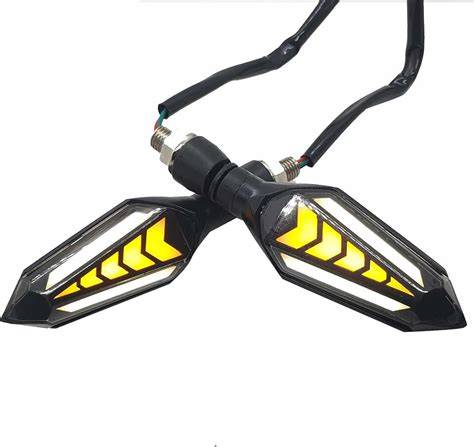
Run a bright white flasher on your tail instead and you are asking drivers to work out something they should not have to. Some of the cheap “white brake” flashers sold online do exactly this, and a white brake signal is the wrong colour by definition. A brake light is red for a reason. If you want a strobe to back up your braking, keep it red and let it speak the language the car behind you already reads.
Brightness is a trap here. A blindingly bright light in the wrong colour is still wrong, and past a point it just annoys the driver you wanted on your side. Correct colour in the correct place beats raw brightness every time.
Where white actually belongs
White is not useless. It has a place, and that place is the front. Facing oncoming traffic, a white or amber light adds to your presence as a running or conspicuity light, on top of your headlight and never instead of it. The one rule that matters up front is simple: do not dazzle the person coming the other way. A light that blinds the rider you are trying to warn has stopped being a safety light.
So if your real plan is a white light pointing forward, that is a front fitting job, aimed and angled with care. It is a different task from a rear strobe, even though both get sold under the same “strobe light for bike” search box.
The red and blue question
You will see plenty of red-and-blue “police style” strobes sitting in the same listings. That combination is tied in most people’s minds to police and emergency vehicles, and copying it is a different goal from being seen. It can also draw the wrong kind of attention on an ordinary road.
Here the honest answer has to be careful. Kroozer strobes are auxiliary visibility lights. Rules on auxiliary lighting, and on colours like red, blue and white, vary by state and by how you actually use the light, so check your local RTO guidance and ride considerately. We wrote a fuller piece on the rules on blinking lights in India if you want the detail. The short version we stand by: the point is to be seen, not to dazzle, and not to pretend to be something you are not.
So what colour is the Kroozer strobe?
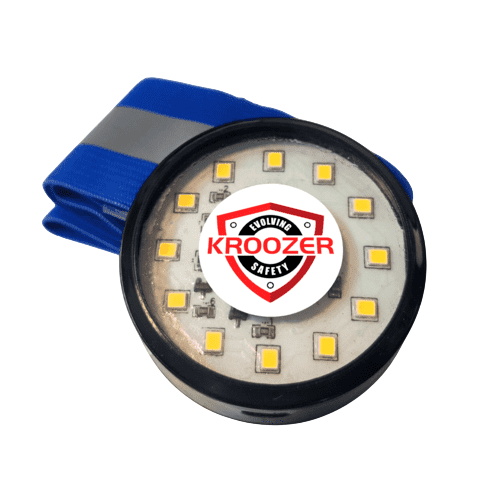
Red. The Kroozer STROBE V7.0 Pro with Brake Mode is built as a rear and side visibility light, so the pods run red, the colour that reads correctly on your tail. Brake Mode wires the pods into your brake light, so when you press the brakes the pods fire and pull the eye of whoever is behind you, alongside the flash patterns you can already run.
The rest is kept simple on purpose. You get a pair, one pod for each side of the tail, on a bolt-on bracket that needs no drilling. There are 20+ selectable patterns and a single push-button switch, so you set it once and forget it. The housing is anodised aluminium and sealed, so rain and a wash do not bother it. It is made in India, it is ₹1,399 for the pair with free shipping across India on orders over ₹1,000, and it carries a one year warranty. To see the full range, our strobe light kits are all in one place.
A quick way to choose
- Match the colour to the position. Red at the rear, white or amber only at the front.
- Do not chase the brightest white light for your tail. Bright and wrong still reads as wrong.
- Treat a white “brake” flasher as a mismatch. A brake signal should be red.
- Look for a real switch, a sealed housing, and a bracket that bolts on without cutting into your bike.
- Decide if you want a wired-in kit or a clip-on. We break that down in which type of strobe suits you.
Get the colour right for where the light sits, and you have done the part that actually matters. A driver behind you should never have to wonder what he is looking at. Red on the tail tells him in an instant: there is a bike here, give it room.


