








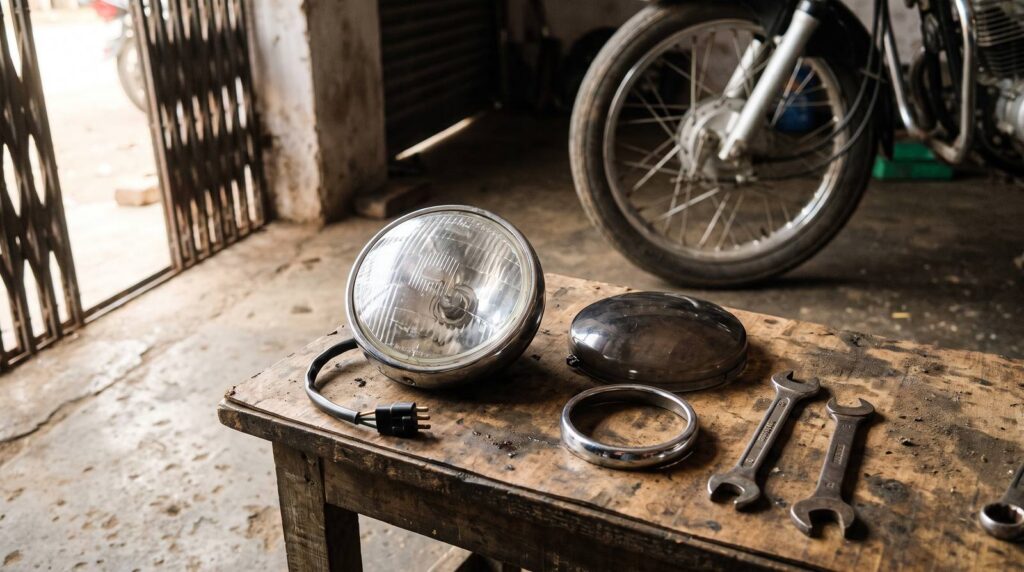
Ask for a modified headlight at any accessory market in India and you will be shown four different things in one breath: a bulb, a whole shell, a lens cover, and a chrome ring. All four get sold under the same word, and they do very different things to the light your bike puts on the road.
That is the part the install reels leave out. Most headlight modifications subtract light, one makes the lamp worse at both of its jobs at once, and it is worth knowing which is which before you hand over the bike.
Four different things people mean by “modified”
1. A new bulb in the old housing
The cheapest move, and the one that goes wrong most often. A reflector housing is a mirror cut around the exact position and shape of the source it shipped with. Put a different source in the same bowl and the light leaves from the wrong place, so some of it misses the road and some goes upward into oncoming eyes. The lamp looks brighter from the front and does less for you from behind the bars. We went through that properly in our guide on why the housing decides more than the bulb does.
2. A whole new lamp assembly
More money, much better odds, because this time the optics and the source were designed together. Most of the genuinely good upgrades sit here, and so does the word projector on the price tag. A projector puts a lens and a small shield in front of the source and gives you a hard horizontal edge instead of a fade: sharper and more accurate, at the cost of some of the spill that was lighting the gutter and the kerb. We went through what the lens actually changes if you are weighing one up.
3. A cover, a tint or a wrap over the lens
This one deserves bluntness. Anything in front of the lens takes light out of the beam. A smoked cover, a tinted film, a mesh grill: light goes in, less comes out, and nothing inside the housing changed to make up the difference.
There is a second cost nobody mentions. A clean glass lens does one small job even with the engine off: it catches a stranger’s headlight and throws a bit of it back. A tint kills that too, so the lens cover charges you on both sides of the deal. You see less, and you are seen less. If you want the darker look, wrap the bucket and leave the glass alone.
4. Rings, eyelids and halos around the lamp
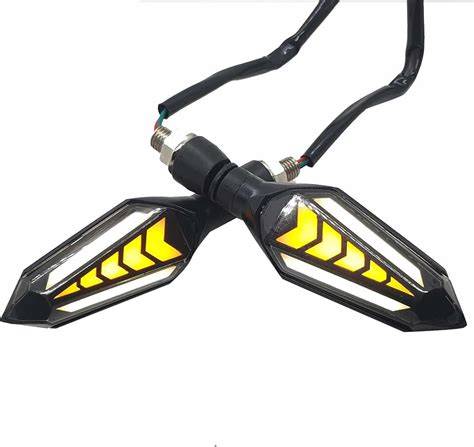
Good news first: these do not touch the main beam, so they cost nothing in the dark. They add a lit shape in daylight, and a shape reads from further away than a bare point.
The catch is where they sit. A halo lives where the headlight lives, in the middle of the bike, so it makes the middle brighter and leaves the width of your bike as hard to read as it was. That matters more than the brightness figure on the box, which we argued at length in what the strongest bike light really means.
So can you change a bike headlight yourself?
Mechanically, on nearly every Indian motorcycle, yes. The lamp sits in a bucket held by two side bolts or a clamp, and the wiring ends in one plug with three pins. Loosen, unplug, swap, plug back, tighten. Buy the right diameter for your bucket and no cutting is involved. Two things are not optional. Aim it against a wall afterwards, because a new lamp rarely lands where the old one sat. And keep it on the harness and switch it was built for rather than feeding a hungrier lamp off whatever was there. Our guide to fog lights and aim covers the wall method, and it applies to the main lamp too.
The colour question, since everybody asks it
The question underneath this search is usually colour temperature, something in the 6000K range, and it usually arrives phrased as a legality question. We do not hand out legal rulings, but the physics is answerable and more useful anyway. A whiter, bluer beam reads as brighter to your eye than a warmer one doing the same work, and in clear dry air that feels like a win. In rain, dust or fog it scatters off the water hanging in front of you and comes back as glare, so you get a bright wall where you wanted a lit road. That is why old fog lamps were yellow. If your riding is monsoon evenings on unlit roads, a slightly warmer beam often shows you more than the whitest thing on the shelf.
What all four modifications have in common
Here is the thread running through the whole list. Every one of them works on what you see. Your headlight is aimed away from you, down the road, as a single point in the centre of the bike. Make that point brighter, sharper, whiter or prettier and you have improved your own view. You have changed close to nothing about how readable you are to the car waiting at the side road.
That driver is not short of bright spots in the windscreen. They are short of width, because two separated lights tell them how far away you are and one cannot, and short of movement, because a steady glow sits still in a street full of shop boards and brake lights. One point on the centreline gives them neither, whatever you spent.
The change that works on the other half of the problem
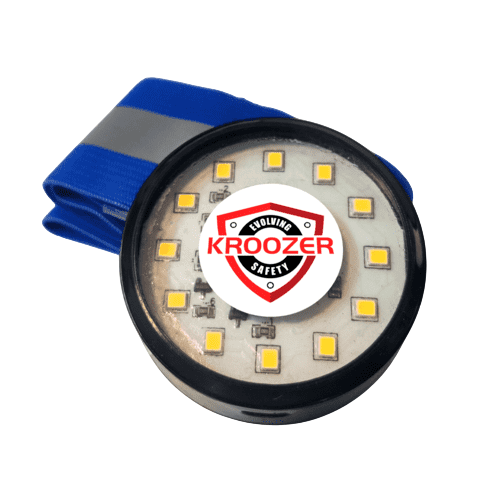
That gap is what we built our strobe lights for. A pair of pods, one each side of the bike, roughly 40 cm apart, on a bolt-on L bracket with no drilling. Two lights with real space between them hand the driver a width to judge, and a flash their eye catches before they have decided to look.
The KROOZER Strobe Light for Bike V7.0 Pro with Brake Mode runs twenty selectable patterns off a push-button switch, so you keep something calm for city traffic and something sharper for a dark highway. Brake Mode wires into the brake light, so the pods fire the moment you squeeze the lever. Anodised aluminium body, universal fitment on any motorcycle, around 15 to 20 minutes with basic tools, supplied as a pair at Rs 1,399 with a one year warranty. Made in India, built in Jaipur by a family that rides. The rest of the range is on our strobe lights page. Free shipping across India on orders above Rs 1,000, and for orders from outside India we quote the shipping cost and confirm it with you before dispatch.
If you are standing in the shop right now
- Bulb only. Cheapest, most likely to leave you with a worse beam than you started with. Worth it only when the housing was designed around that kind of source.
- Whole assembly. The honest upgrade for seeing. Costs more, needs aiming.
- Covers and tints. They look the part and cost you light at both ends.
- Rings and halos. Harmless, mildly useful in daylight, still in the middle of the bike.
- Anything on the sides. The only entry here that works on being seen rather than seeing.
You do not have to choose one. Just be honest about which problem you are paying to fix, because the headlight fixes the seeing and nothing on the bike’s centreline fixes the being seen.
Whichever way you go, ride considerately. A lamp that dazzles the person coming towards you has not made the road safer, it has handed the problem to somebody else. Rules on motorcycle lighting vary by state and by how a light is used, so check your local RTO guidance before you fit anything. The point is to be seen, not to blind.


