





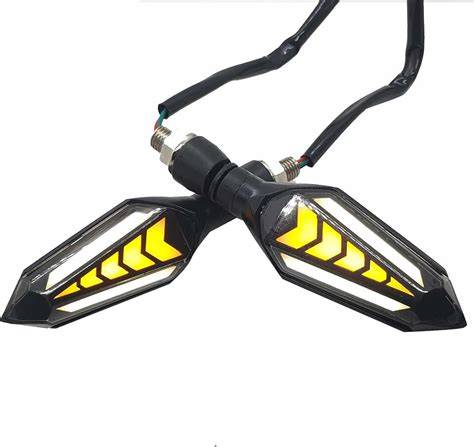


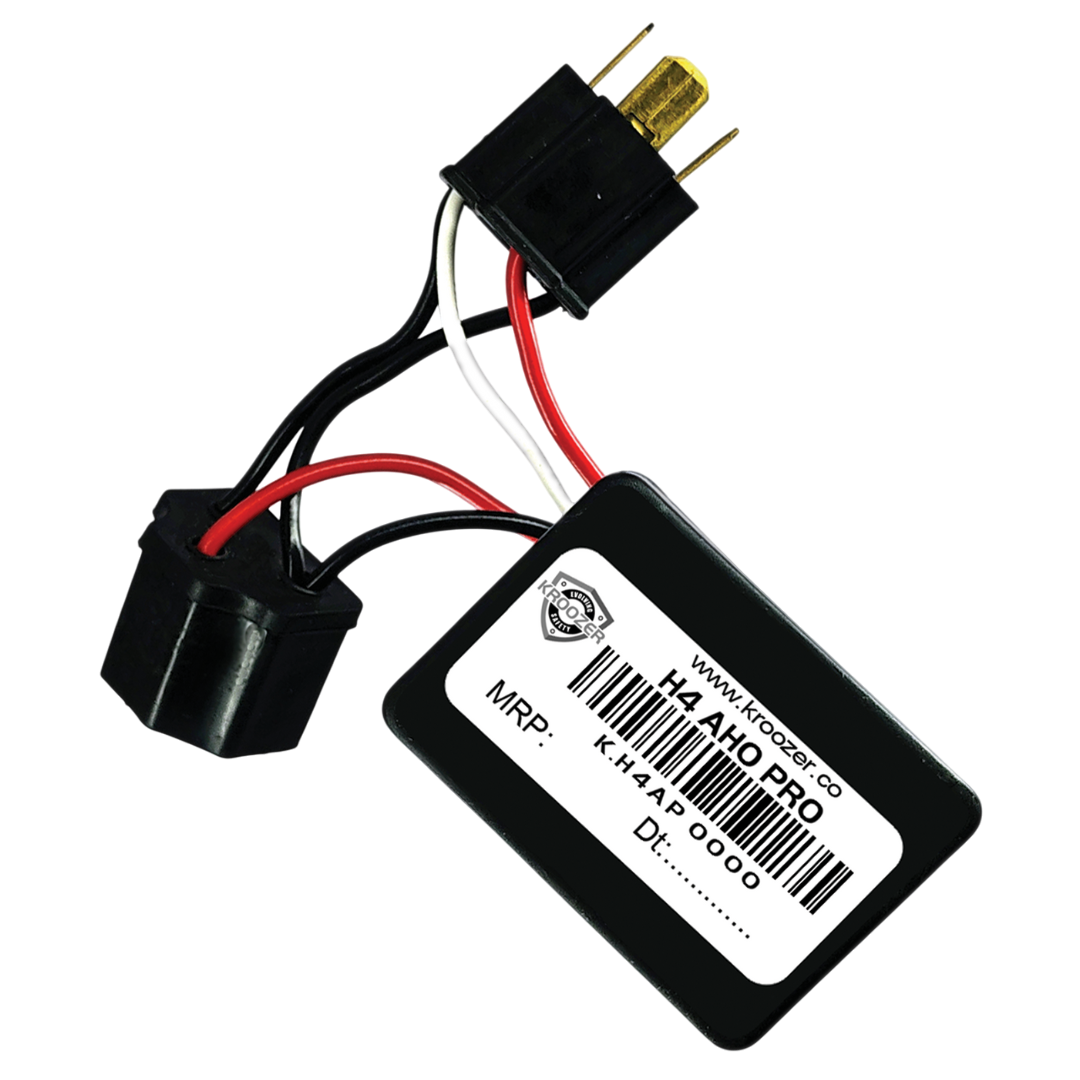

Search “projector headlight for bike” in India and the first screen hands you three different objects under one name. A bulb that drops into the headlight you already own. A whole assembly that replaces the shell. And a small round lamp, often under a few hundred rupees, that is really an auxiliary spot lamp wearing the word headlight. They do not do the same job, do not fit the same way, and only one is actually a headlight.
So start with the mechanical question rather than the shopping one. A projector is not a brightness grade, it is a different way of pointing light, and knowing what the lens does sorts out most of that results page.
What the lens actually does
An ordinary headlight is a mirror. The bowl behind the bulb is cut so that light leaving one small point is folded forward into a usable shape, and the glass in front is mostly a cover. Everything useful happens in the reflector, and only if the light source sits where the mirror expects it.
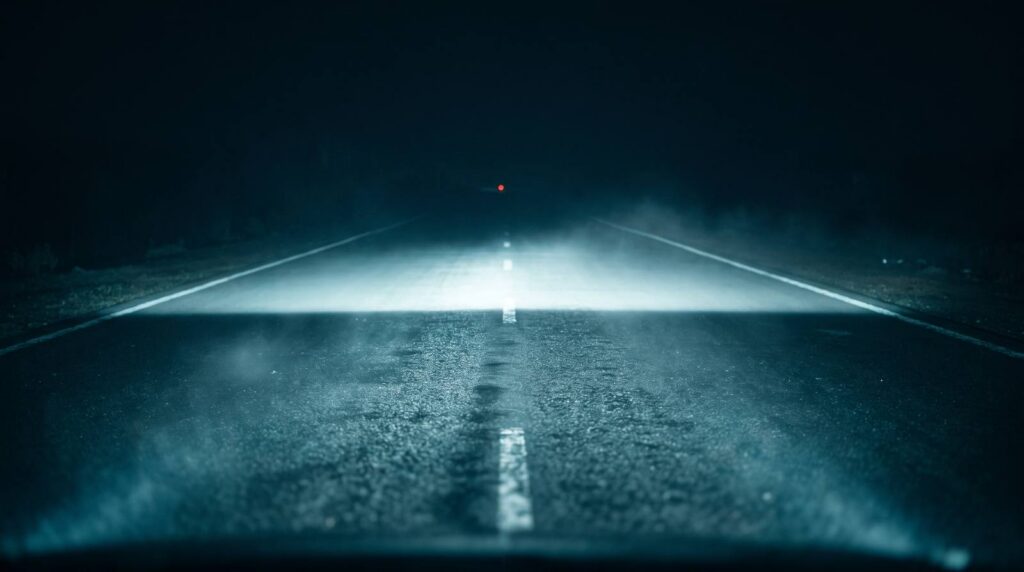
A projector throws that away and works the way a slide projector does. Light goes into a lens, and between the source and the lens sits a small metal shield. The lens images the edge of that shield onto the road. That is the whole trick. The sharp horizontal line at the top of a projector beam is not clever electronics, it is the shadow of a piece of metal, in focus.
That is why a projector reaches further without throwing more light into the oncoming lane: the shape is decided inside the housing instead of depending on the bulb landing in exactly the right spot. We covered that dependency in the guide on why the housing decides what an LED headlight does, not the bulb, and the projector is the clean answer to it rather than a workaround.
Do you already have one?
Riders ask this constantly and nobody selling the parts answers it. You can settle it by looking, in daylight, with the lamp off.
Put your face close to the glass and look for depth. A projector has a bowl inside the headlight: a clear glass dome in a short barrel, and at an angle you can usually see the lip of the shield down near the bottom, a straight dark edge where there is otherwise curve. A reflector has no dome. It is a mirrored or faceted bowl with the bulb in the middle of it.
The other tell is the beam on a wall. A reflector fades out at the top. A projector stops, with an edge you could almost run a finger along. A soft gradient means a reflector, whatever the photos implied.
Three things, one word
The drop-in lens bulb. An H4 shaped unit with a small lens on the nose, sitting in your standard bulb holder. Cheapest route to a cut-off, and better than a bare LED board in a reflector because at least something is shaping the light. It is still a small lens inside a bowl built for something else, so expect a tidier edge, not a transformation.
The full projector assembly. Shell, lens, shield and mount as one unit, replacing the original headlight. The real version, and the one needing most thought: the mounting ears must match your fork or fairing, the bore has to clear the cluster, and the wiring is bare leads rather than your bike’s connector.
The auxiliary projector pod. Small, round, sold singly or in pairs, titled as a headlight and listed near the words spot and fog. It is neither. It is an extra lamp for the crash guard, with no low beam and no business being your only forward light. If the listing shows a bracket rather than mounting ears, it is a pod.
What you give up
Every page selling projectors lists the advantages. The answer to the other question is shorter and more useful.
You lose spill. A reflector leaks light sideways and some of that leakage does real work, lighting the gutter, the dog, the kerb you are about to clip. A projector gathers it and sends it up the road. On an open highway that is a straight gain. In a lane at low speed you can end up seeing further and noticing less.
Aim matters more, not less. A sharp edge is only useful where it is put, and the cut-off that keeps light out of a driver’s eyes will deliver it there precisely if the unit sits higher than the original lamp or points a touch upward. Mount a projector above the standard headlight line and you have built an accurate way of dazzling people. The guide on what aim and mounting height decide for an extra forward lamp applies here without changes.
Heat goes backwards. In an LED lamp heat leaves through the base, not the front, so a projector needs air behind it. Sealed into a tight fairing it cooks itself, and if it solves that with a fan you have added the only moving part in the system. Moving parts go first, as the guide on what fails on a bike light and in what order sets out.
And the figure on the box tells you little. It describes what goes in, not what lands on the road, and a tight cone with a big number behind it still leaves a bright patch and a dark distance, as the guide on why the strongest light is not the answer sets out.
The thing a projector cannot buy you
A projector makes your forward light narrower and more accurate. Narrower and more accurate is exactly right for seeing. It is exactly wrong for being seen. To the car waiting at a side road, your headlight is one small point of white with no width to it, nothing to judge your speed by and nothing to judge your distance by. Tighten that point and the seeing gets better while the being seen gets slightly worse. To the two vehicles closing from behind, the headlight has never done anything at all.
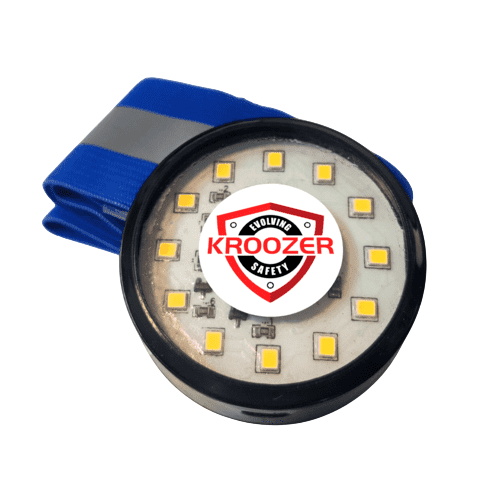
Being seen is a different job, bought with size, position and movement rather than reach. That is why the KROOZER Strobe Light for Bike V7.0 Pro with Brake Mode is supplied as a pair rather than one brighter lamp. One pod per side, roughly 40 cm apart, gives a driver two separated points instead of one, and two points carry width where a single point carries none. The 20 selectable flash patterns give the movement, and Brake Mode wires into the brake light so both pods fire when you brake. Push-button switch, bolt-on L bracket, no drilling, about 15 to 20 minutes on the stand. Rs 1,399 the pair, universal fitment, anodised aluminium, made in India, one year warranty, free shipping across India on orders above Rs 1,000. International orders are placed as usual and we quote the shipping cost and confirm it with you before dispatch. The rest of the range is in our strobe light collection.
Worth saying plainly: these are auxiliary visibility lights. Rules on auxiliary lighting vary by state and by how the light is used, so check your local RTO guidance and ride considerately. The point is to be seen, not to dazzle.
If you are buying this week
- Look into your own headlight first. A dome and a shield already in there means a projector bulb solves a problem you do not have.
- Decide which of the three objects you want. Mounting ears versus a bracket is the test.
- Check the beam on a wall after fitting. Flat top edge, below your own eye line at a few paces, or the aim needs work.
- Leave air behind the lamp.
- Then ask the separate question: what can the traffic behind and beside you see? The headlight never answered that one.


