





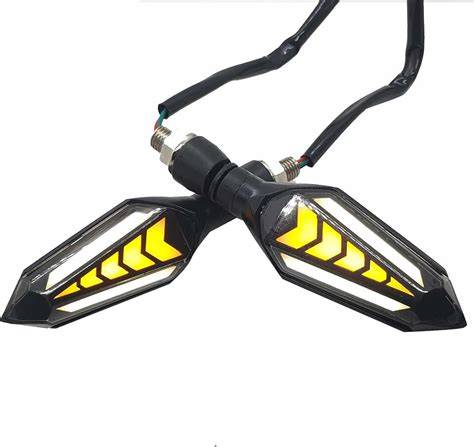




Short version: while you’re riding, no. A pair of strobe pods is one of the smallest things you can hang off a motorcycle’s electrics. Your engine is already running a headlight. The strobes ask for a fraction of that, and while the motor is turning, the charging system is covering it. The battery isn’t paying the bill.
The battery only starts paying when the engine stops. And that is where nearly every real “my strobes killed my battery” story comes from. Not the light. The wiring behind it.
Why every answer you found was about something else
Search this question and you get a wall of results about hazard lights left blinking on a parked car for ten hours, LED strips glued under a bike, headlight conversions, or somebody’s underglow that runs off an app. Then a few forum threads where four people disagree and nobody says what they were actually riding.
None of that is a pair of small pods on brackets, wired properly, switched on for a ride through evening traffic. The situations aren’t comparable, so the answers aren’t either. Hazards on a parked vehicle are the extreme case: engine off, nothing replacing what’s being used, hours going by. That is the opposite of how an auxiliary light gets used.
What a flashing light is actually asking for
A strobe spends most of its life switched off. That is the entire point of it. The gap between flashes is what makes a driver’s eye catch you, and a light that’s dark more often than it’s lit is asking for less than the same light held steady. A small LED pod held steady is already a modest ask next to your headlight, and the pattern cuts it further.
Add to that: you use them when you’re moving. Filtering through traffic, riding home after dark, sitting in the rain at a junction hoping the car behind has seen you. Engine running, charging system doing its job.
So when do they genuinely flatten a battery?
Four causes, and only one of them has anything to do with the light itself.
1. It’s wired to something that stays live with the key off
This is the big one. If the feed is taken from a permanently live point rather than one that dies with the ignition, the accessory can keep sipping after you’ve walked away. Leave the bike for a week and you come back to a click instead of a crank. The light did nothing wrong; it was simply given a supply that never switched off.
2. It got left switched on while parked
Easy to do on a bike you’ve just fitted something to. You’re pleased with it, you’re showing someone, you walk off. A switch you can find by feel, in a spot your thumb naturally reaches, prevents more of this than any amount of technical specification.
3. The battery was already on the way out
Two or three summers in, a battery that struggles on cold mornings and needs a few extra cranks is not being killed by an accessory. It is being exposed by one. Fitting anything new to a tired battery is how a slow decline becomes an obvious problem, and the new part gets the blame.
4. Everything got piggybacked onto one tap
Auxiliary lamps, a loud horn, a phone charger, a dashcam, all taken off the same convenient wire someone found once. Individually fine. Together, not fine. This is the failure people describe when they say the bike “couldn’t handle” the lights, and it’s really a story about how the whole lot was joined up.
How to wire it so it simply can’t happen
- Take the feed from a circuit that dies with the ignition. If the key is out, the accessory is dead. This one decision removes the most common cause outright.
- Fuse the feed. Not for battery reasons, but for the reason you fuse anything.
- Put the switch where your thumb finds it. If you have to look for it, you’ll forget it.
- Route the loom where it can’t chafe. Along the subframe, away from anything that moves or gets hot, secured properly rather than tucked and hoped for.
- If the electrics aren’t your thing, don’t guess. Any competent local mechanic will do this in one sitting. There is no shame in it and it costs less than a battery.
We walk through the actual routing on a specific bike in our guide to fitting strobe lights to a Royal Enfield, and the same logic carries over to most commuters and tourers.
How to tell whether it’s the lights or the battery
Before you pull anything off, work out what you’re actually dealing with. Ask yourself:
- Does it go flat after the bike sits, or after you ride it? Flat after sitting points at something staying live. Struggling after a ride points at charging or the battery itself.
- How old is the battery, honestly? Count monsoons, not months.
- Are your rides short? A run of ten-minute hops never really gives a battery a chance to recover from starting the bike, whatever else is fitted.
- Did it start the week you fitted something, or a while after? Timing tells you a lot.
- Disconnect the accessory for a week. If the problem stays, you’ve found your answer and it isn’t the lights.
What we’ve done about it on ours
Our KROOZER Strobe Light for Bike V7.0 Pro is a pair of small aluminium pods on bolt-on L-brackets, one each side, roughly 40 cm apart. No drilling. Most people have them on in fifteen to twenty minutes using bolts already on the bike.
They run off a push-button switch, so turning them off is one deliberate press rather than a menu or an app you’ll forget to open. There are more than fifteen selectable patterns, and Brake Mode ties into your brake light so the pods fire when you touch the lever. The housing is sealed and weather-resistant, which is what matters through a monsoon. They’re made in India, ship free across India on orders over ₹1,000, and carry a one-year warranty. Sold as a pair, at ₹1,399.
You can see the rest of the range on our strobe lights page. If you’re weighing this up against a brake light flasher, that’s a genuinely different product and we’ve written about the difference between the two.
Where that leaves you
Battery worry is the reason a lot of riders never fit visibility gear they’d benefit from. It’s a fair worry, and it deserves a straight answer rather than a spec sheet: wired to a switched circuit and turned off when you park, a pair of strobe pods is not what’s going to leave you stranded. A five-year-old battery and a fortnight of ten-minute rides is far more likely.
Get the wiring right once and you can stop thinking about it. Be visible. Be home.


