





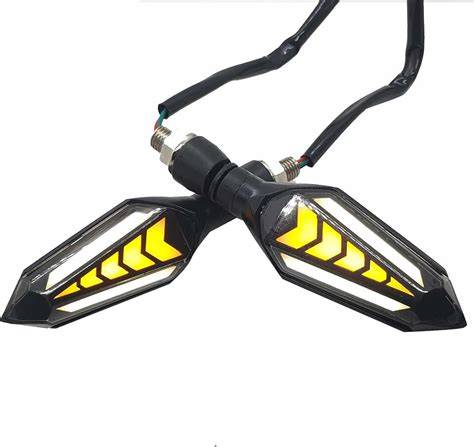




Short answer first: the part everybody worries about is the part that almost never fails. An LED does not burn out the way a filament bulb does. When a strobe light on a motorcycle stops working, something else on it gave up, and that something is nearly always water, movement, or the mount.
Which one gets you was mostly decided the day the light went on the bike, so that is where this answer starts.
Hours are the wrong unit
Ask how long a light lasts and you expect a number of hours back. Fair enough for a bulb. It is close to useless for a strobe pod on an Indian road.
Start with how little the thing is actually lit. A strobe is dark more often than it is bright, and the gap is the whole point of it. Then look at what the pod goes through between flashes. Vibration every time the engine turns. Heat off the exhaust side. Water thrown up by the wheel. Dust in April, monsoon in July, dust again by October.
None of that is measured in running hours. Count seasons instead. A pod that comes through its first full monsoon dry inside and tight on its bracket will usually keep going for years. One that took in water that July is on a clock from then on, however few hours it has been lit.
The four things that actually end a strobe light
1. Water finding a way in
Every sealed housing has the same three weak points: where the light gets out, where the wire goes in, and the seam between them. Water rarely arrives dramatically. It arrives as a slow, repeated push. Spray off the wheel. A puddle taken faster than you meant to. A pressure washer held against the pod at the Sunday wash.
What finishes the light is not the drop itself. It is what that drop does to the contacts inside over the next fortnight, through the warm and cold cycle of a bike that gets ridden, parked, and ridden again. This is why a light that comes through one monsoon tends to come through the next, and why one that misted up once will almost always mist up again.
2. The wire where it moves
A loom does not fail along its length. It fails at the two or three places where it is asked to bend: right where the cable leaves the pod, and anywhere it crosses something that moves relative to the frame. Every pothole and every full lock of the bars works that spot a fraction, and copper does not enjoy being worked.
You rarely see it coming, because the outer sleeve looks perfect while the strands underneath have been quietly parting for months. The symptom is a light that flickers on a rough road and behaves itself on smooth tarmac. Riders read that as a gremlin somewhere in the electrics. It is usually a wire that is nearly through.
3. The mount letting go
Adhesive pads and cable ties are honest about what they are. Heat softens the glue, water creeps under the edge, and a stuck-on pod eventually parts company with the bike, usually without you noticing until you park. The light still works. It is just not on the bike any more.
A bolted bracket moves the problem somewhere better, but does not delete it. A fastener nobody has looked at since fitting day can back off over a season of Indian road, and a bracket that is only nearly tight chews its own mounting point long before it falls off.
4. The switch and the connector
The quietest failure, and the most common one on older installs. A push-button switch is a mechanical part with a contact inside it. A connector in the loom is two bits of metal held together by friction. Both live outdoors, both are fine for years while they stay dry and still, and both go high resistance and intermittent once damp has been sitting in them.
Worth knowing before anybody bins a set of lights: this is the cheapest failure here to put right. A connector can be cleaned or replaced in an afternoon, and the pods need not follow it into the bin.
A pod with a cell in it has a different clock
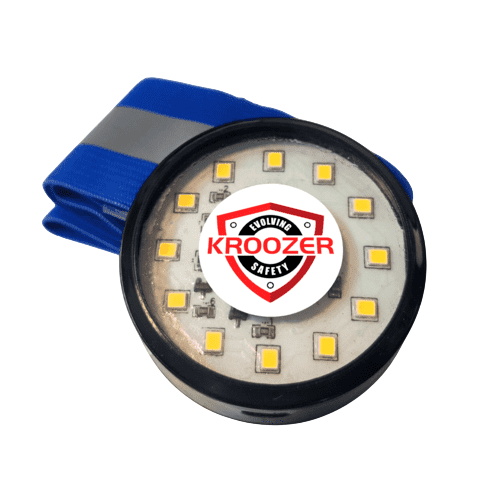
Everything above applies to a light wired into the bike. A pod with its own rechargeable cell has one more thing that ends its life, and it is the one that ends it first.
A cell has a limited number of charge cycles in it, and it starts giving you less time on each charge long before it refuses to charge at all. Nothing has broken. It is doing exactly what cells do. On a clip-on you use every night, that clock runs faster than any of the four failures above, which is why those lights get replaced rather than repaired.
That difference is real, and it is a large part of what separates the price bands. We split the market on it in which bike strobe light is best, and worked through the money side in how much strobe lights cost in India.
How to get years instead of months
Check the fasteners after the first few rides. A bracket beds in, and if a bolt is ever going to loosen it will do it early. After that, once a season is plenty.
Point the connector down. Water runs downhill even inside a loom. A joint that faces up is a cup.
Leave slack where the cable bends. Not a loop dangling near the chain. Just enough that the bend happens over a length of cable instead of at one point against the housing.
Keep the jet off the seams. Wash the bike properly, by all means. Do not aim a pressure washer at the point where the wire enters the pod. That joint is built to keep out weather, not a nozzle held against it.
Rinse after salt and mud. Coastal air and monsoon slurry are harder on a connector than rain.
What we build, and why it is built that way
Ours, so read it with that in mind. The KROOZER Strobe V7.0 Pro with Brake Mode is a pair of anodised aluminium pods, one per side, on bolt-on L-brackets roughly 40 cm apart, in a sealed and weather-resistant housing. No drilling, and most owners have it on the bike in 15 to 20 minutes. There are 20+ selectable patterns on a push-button switch, and Brake Mode ties the pods into the brake light so they fire when you brake as well as running their pattern. It fits all motorcycles. Made in India, ₹1,399 as a pair, one year warranty against manufacturing defects, and free shipping across India on orders over ₹1,000. The rest of what we make sits on the strobe lights page.
Three of those choices exist for this question rather than for a sales page. A bracket instead of a pad. A sealed housing instead of a flap. A feed from the bike instead of a cell, which raises its own question, answered in do strobe lights drain your bike battery. Each removes a clock. None removes all of them, which is why how it goes on the bike matters as much as what you bought.
So how long?
Long enough that the honest reply is three questions back. How is it mounted? Where does the wire bend? Which way does the connector face? Those answers predict the life of a strobe light better than anything printed on the box. Fit it properly, look at it once a season, and it will still be doing its job the day you sell the bike. Skip that and you will be shopping again before the next monsoon. Be visible. Be home.


