








Yes, an LED helmet light makes you easier to see, and it does it in a way none of the lights on your bike can. Your tail lamp, your indicators and any strobe you have fitted all sit low, at bumper height, where the car directly behind you hides them from everyone further back. A light on the back of your helmet sits at the top of the picture, roughly level with a driver’s eyes, and it moves when you move. It puts a signal where drivers are already looking, and it makes that signal look like a person.
It is not a replacement for the lights on the bike, and anyone who sells it to you that way is overselling. It is a top layer. Here is what it adds, where it should sit, which mode to ride with, and whether to buy a stick-on kit or a helmet with the lights built in.
What a helmet light does that your bike’s lights cannot
Think about the last time you sat in a queue at a signal at night. The car behind you could see your tail lamp. The bus two vehicles back could not, because the car was in the way. From the bus driver’s seat, your helmet was the only part of you that existed.
That is the first thing a helmet light buys you: height. The second is motion. A tail lamp is a fixed red point among a hundred other fixed red points. A light on a helmet bobs when you check your mirror and swings when you look over your shoulder. Human eyes are wired to notice a light that moves like a head. It reads as a person, not as a fitting.
The third is independence. The helmet light runs on its own charge, so it keeps working when the bike is switched off at the roadside, when you are pushing it across a dark parking lot, or when you are the pillion with no lights of your own. A pillion’s helmet is the highest point on a loaded bike, and usually the darkest.
What it cannot do
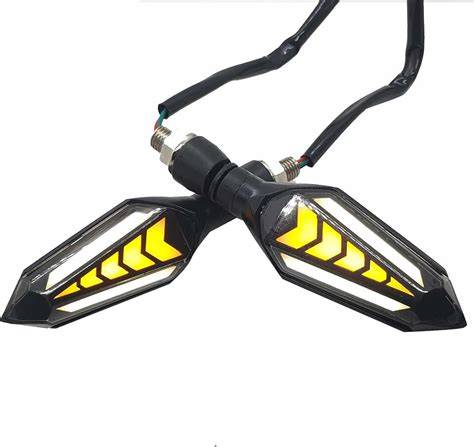
A helmet light carries no message. It cannot tell the driver behind you that you are braking, because it is not wired to the brake, and it cannot tell them which way you are turning. It says one thing only: there is a person here. The bike’s own lights still have to do their jobs. If you want a brake signal that is hard to miss, that is what a strobe kit with Brake Mode is for.
It is also small. One LED unit on a helmet is a dot, not a floodlight. Its job is to get you noticed early, then let the bigger lights on the bike take over. And it is a battery device, so charge it on the same evening you charge your phone.
Where it should sit on the helmet
Low on the back of the shell, centred, just above the rim. Not on the top, where the curve of the shell points it at the sky. Not on one side, where only one lane sees it. Never near the visor or the edge of your vision. Centred and low, it faces straight back at the traffic that matters most, whether you are upright in town or tucked forward on the highway.
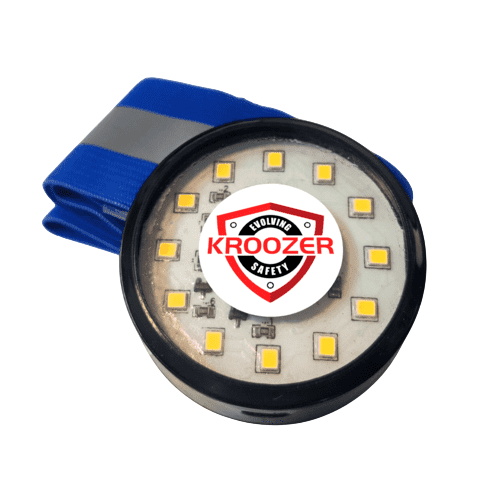
Do not drill a helmet shell, ever, for any accessory. A hole in a helmet is a hole in the thing that protects your head. Every helmet light worth buying attaches without tools. The STRIKE-R 3.0 kit, for example, uses a low-profile Velcro pad: one side fixed to the shell, the other on the light, so the unit lifts off for charging and leaves the helmet clean when you take it away. There is a spare pad in the box for a second helmet. Clean the shell before you stick the pad down and let the adhesive settle before the first ride.
Which mode to ride with
The STRIKE-R has five modes, from a steady ring of light through to a hard blink. The tempting choice is the fastest flash, because it feels like more. Resist it for ordinary riding.
A flash is very good at grabbing attention and poor at helping someone judge how close you are. That is the same trade-off we wrote about in whether flashing bike lights are actually safer, and it applies on the helmet too. A steady mode gives the driver a fixed point to track. Save the blink for fog, heavy rain, a dust storm, or a stretch of unlit highway where nobody expects a bike, and switch back when it clears. If you ride with a pillion often, two units, one on each helmet and both steady, do more than one on a frantic setting: two points of light read as width, and width is what tells a driver you are a vehicle.
Stick-on kit, or a helmet with the lights built in?
If you already own a helmet that fits you properly, keep it and add a kit. The STRIKE-R fits any helmet, full-face, open-face, half-face or modular, from any brand sold in India, and it moves with you when you change helmets. It is listed at Rs 399 at the time of writing, against a regular price of Rs 999, plus Rs 80 flat shipping within India, and it carries a one-year warranty on manufacturing defects.
If you are buying a helmet anyway, a shell with the lights built in is tidier. The i-LLUXX Rox is a Steelbird Roxx shell with three LEDs set into the rear spoiler, so there is nothing stuck on and nothing to lose. The trade is flexibility: the lights live and die with that one helmet.
Either way, the light is one layer of a stack, and we laid the whole stack out in how to be more visible on your bike at night and in the rain.
A word on rules
People ask whether a flashing light on a helmet is allowed. Rules on auxiliary lighting vary by state and by how a light is used, so read the rules on blinking lights in India for the longer picture and check what your local RTO says. Then ride to be seen, not to dazzle: keep the light off the visor and out of anyone’s eyes at a signal.
Quick answers
Does an LED helmet light drain my bike’s battery?
No. It is self-contained and charges over a micro USB port, so nothing is wired to the bike. The kit lifts off its Velcro pad to charge.
Will it cope with the monsoon?
The unit is built to shrug off rain and road spray. Fit the pad to a clean, dry shell, and wipe the lens when you wipe your mirrors.
Is a helmet light a replacement for a strobe on the bike?
No. The helmet light says a person is here, from up high. A bike-mounted strobe with Brake Mode says this vehicle is slowing. If you can only sort one this month, fix the bike first and add the helmet light next.
Be visible. Be home.


