









Ask in any riding group and you get two answers in the same thread. One rider says fog lamps are completely fine, he has run a pair for three years. The next says he was pulled over in Bengaluru and paid a challan for two small white pods. Both are telling the truth about what happened to them. Neither is telling you the rule.
We make motorcycle lighting in Jaipur, so this one reaches us most weeks, and in a rush every October when the mornings go white.
The bit we are not going to pretend about
We will not tell you a fog lamp on your bike is fine and you can stop worrying. That is not ours to say, and it is not one answer anyway: auxiliary lighting sits across central motor vehicle rules and state level enforcement, and it is the second half riders meet on a Tuesday morning. What we can tell you is what those rules are written around, because that part is consistent and it is exactly what a constable is looking at. Check your own state’s RTO guidance before you fit anything.
Four questions everything comes back to
Where does it sit? Auxiliary lamps are expected to sit below the line of your main headlamp. Not above it, and not out on the handlebar. On a motorcycle that means the crash guard or a low bracket near the fork bottoms. Riders get this wrong more than anything else, and not out of defiance: handlebar clamps are the easiest mount to fit, and they put the lamp exactly where it should not be.
What colour is it? Front auxiliary lighting is expected to be white or a warm yellow. The colours that read as an emergency vehicle are not yours to use, in any direction, in any weather.
Where does it point? Down, onto the road, not out at eye height. That is the whole argument, and it gets its own section below.
When is it switched on? A fog lamp is for fog, heavy rain, dust and smoke. Running a pair at full blaze down a clear, well lit city road at nine in the evening is what gave the category its reputation. Most riders in trouble are not in trouble for owning the lamp. They are in trouble for when they had it on.
Aim is the whole argument
Nearly every fog light complaint you have heard is a complaint about glare. Not brightness in the abstract. Light arriving in somebody’s eyes.
A lamp mounted low and tilted down lays a wide pool on the tarmac just ahead of your front wheel and stops there. The same lamp clamped high on the bar and left level throws that light into the face of the man coming the other way. Identical lamp, identical output. One is a tool, the other is a nuisance, and the difference is one bolt and about five degrees.
So after you mount them, park square on to a wall a few steps away and see where the hot centre of the beam lands. If it sits above the height of your own handlebar, tilt it down until it does not. Two minutes, and it settles most of the argument before it starts.
What fog actually does to light
Fog is water hanging in the air, and every droplet behaves like a tiny mirror. Push a strong beam into it and a good share of that light comes back at you as a flat white wall. This is why a rider switches on a powerful headlamp in thick fog, sees less than before, and decides the fog has got worse. The fog did not change. He lit it up.
That is why a real fog lamp sits low and throws a wide, flat, shallow beam. It slides light underneath the fog and onto the road surface, where it can show you the edge of the tarmac and the pothole. Low and wide beats high and bright, which is also why the cheap pencil beam spot lamp sold as a fog light is the worst thing you can buy for real fog.
The mistake that costs more than a challan
A fog lamp is a seeing light. It exists so you can see the road. It does very little about the other problem, which is whether anybody sees you.
On Indian roads that is the harder half by a distance. The car that pulls out of a side lane, the one that drifts into your line on the highway, the one that closes on you at a wet red light: none of those drivers failed because they could not see the road ahead. They failed because they never registered that a motorcycle was there, and they never registered it because one steady red tail lamp on a narrow vehicle is among the easiest things in Indian traffic to lose against headlights, hoardings and wet reflections.
Your fog lamps face forward. The driver most likely to hurt you is behind you or beside you.
Being seen is a different job with a different answer
Human eyes are not especially good at noticing bright. They are very good at noticing change. Something that alters is picked up in peripheral vision well before a steady light of the same output, which is why almost everything hard to miss on a road, from an ambulance to a level crossing, moves rather than simply glows.
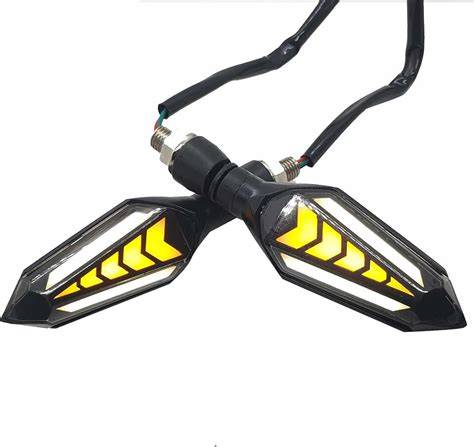
That is the job our own product is built for, and we would rather be plain about which half it solves. The KROOZER Strobe Light for Bike V7.0 Pro with Brake Mode is a pair of small red pods that sit low at the rear and sides and give the driver behind you something that changes instead of something that sits still. There are 20 selectable patterns on a push button switch, and Brake Mode wires into your brake circuit so the pods fire the instant you pull up. That one earns its keep more than anything else on the list, because the moment you are most exposed is the moment you slow down and the man behind you has not worked it out.
It bolts on with an L bracket, one pod each side, no drilling, fitted in fifteen to twenty minutes. Anodised aluminium housings sealed against rain and road spray, universal fitment across motorcycles, made in India, one year warranty. Rs 1,399 for the pair, with free shipping across India on orders over Rs 1,000, and we ship overseas too, with the cost quoted and confirmed before dispatch. The rest of the range is in our strobe lights for bikes.
The same caution applies to ours as to any fog lamp. Kroozer strobes are auxiliary visibility lights, the rules vary by state and by how you use the light, so check your local RTO guidance and ride considerately. The point is to be seen, not to dazzle. We wrote that one up in our guide to the rules on blinking lights in India, with a companion piece on what a flash does well and what it cannot do.
So should you fit fog lamps or not?
If you leave the city before sunrise, if you cross open country in December and January, if your ride home includes an unlit stretch of broken road, then yes. A low, properly aimed pair is a genuinely good buy, and the first winter morning you use them you stop debating it.
Just fit them for the right reason. Below the headlamp. Aimed down at the road. Switched off when the road is clear and lit. And do not walk away believing you have solved visibility, because you have solved the half that faces forward. The other half is behind you, and that is the half the driver is in. For the full picture on that side, start with how to be more visible on your bike at night and in the rain.


