








A rider asked us this in the DMs last month, and it deserves a straight answer rather than a sales pitch: is there anybody who shouldn’t be running strobes?
Yes. Two groups. We would rather tell you now than have you find out later.
The people who should genuinely be careful
A small number of people with epilepsy are photosensitive, which means flashing light at certain rates and patterns can trigger a seizure. That is a real medical condition, not an internet rumour. If you have photosensitive epilepsy, or someone who rides pillion with you regularly does, talk to your doctor before you fit anything that flashes, and take the answer seriously. No accessory is worth that.
The second group is easier to describe. If the reason you want flashing lights is to bully the car ahead of you out of your way, please buy something else. That is the use that gives auxiliary lighting a bad name, and it is the opposite of the point. We are trying to sell you being seen, not being feared.
For everyone else, the honest answer isn’t “avoid”. It’s “set them up properly”, and that is the part almost every product listing skips entirely.
You are meant to choose a pattern, not just a light
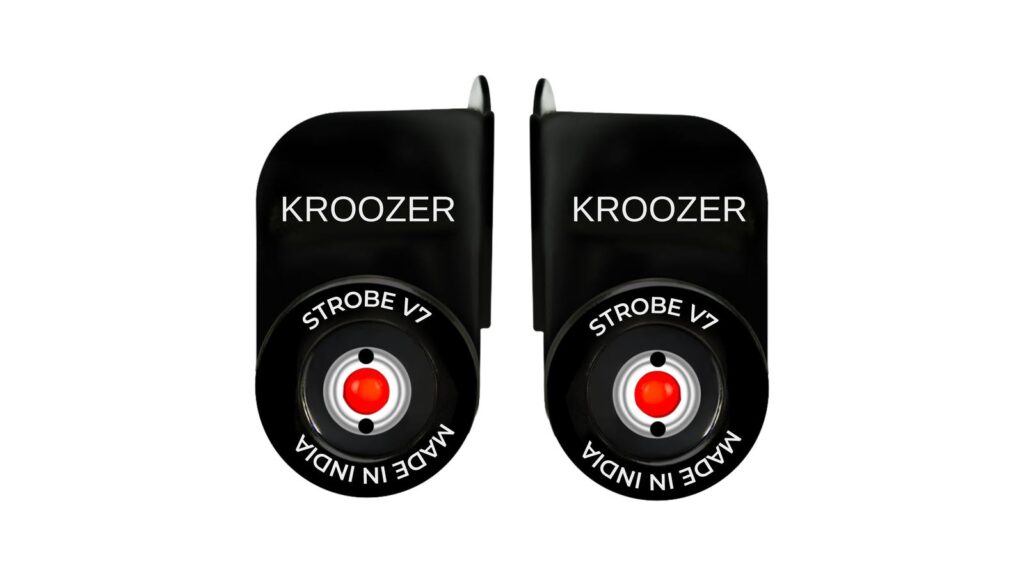
The KROOZER Strobe V7.0 Pro with Brake Mode gives you more than fifteen selectable flash patterns, cycled with a push-button switch. What most riders do is press that button in the parking lot until something looks good standing still, and then never touch it again.
Standing still is the wrong place to judge it. A pattern that looks sharp when you are parked can be a mess at 60 on a dark highway, and a pattern that seems tame in your garage can be exactly right in grey monsoon light.
Think of the patterns in three rough families, and pick by conditions rather than by looks.
Slow and spaced out. A calm, unhurried flash. This is your default for city riding and stop-go traffic. It says “there is a vehicle here” without demanding anything from anyone. If you only ever learn one setting, learn this one.
Quick double or triple pulses. More assertive, and genuinely useful in poor daylight. Overcast afternoons, dust, drizzle, that flat grey hour before the rain actually starts. Daytime is when riders get looked straight through at junctions, and this is the family that helps there.
Fast, continuous, attention-grabbing. The dramatic ones. These have a narrow proper use, which is being broken down or stopped somewhere you should not be stopped, on a highway shoulder at night waiting for help. They are not a riding mode. Using them as one is how you become the rider everyone complains about.
Nobody can tell you the single correct setting, because it depends on your route, your light and your traffic. What we can tell you is that if you have never changed it since the day it was fitted, you are almost certainly not on the right one.
Brake Mode is the setting that isn’t really a pattern
This is the part people miss when they compare products on a marketplace listing. Brake Mode wires into your brake light, so the pods fire when you actually brake. It runs alongside the flash patterns rather than instead of them.
It matters because the moment you most need the driver behind you to notice something is the moment you slow down suddenly. A rear-end shunt in traffic is not usually a case of somebody not seeing your bike at all. It is a case of not registering, quickly enough, that your bike is now slowing.
If you are weighing this up against a simple brake-light flasher module, we wrote a whole piece on how brake light flashers and strobe lights actually differ, because they get sold as the same thing and they are not.
When to switch them off
This is the etiquette nobody prints on the box, and it is most of the difference between a rider people respect and a rider people report.
- Stopped at a signal, right behind someone. Switch off. You are right on their bumper, filling their mirror, and there is nothing to be gained by it.
- Slow residential lanes late at night. Switch off. Everybody is doing 20 and nobody needs it.
- Thick fog, following close. Ease off the aggressive patterns. In heavy fog, flashing light bounces back off the water in the air, and there is a point where you are making things harder to read rather than easier for the driver behind you.
- Any time you find yourself thinking “this will make them move”. Switch off, and have a word with yourself.
The push-button switch exists precisely so that turning them off is a one-second job. Put it somewhere your left thumb can reach without letting go of the bar.
Where the line actually is
Here is how we think about it, and it is a decent test for any lighting decision you make on a motorcycle.
Being seen means a driver’s eye catches you a moment earlier than it otherwise would, and they make a slightly better decision because of it. Dazzling means they look away, or squint, or lose the road for a second. The first one makes you safer. The second one makes everybody less safe, including you, because a driver who cannot see properly is a driver who cannot avoid you.
Everything above is really just that one line applied to different situations.
The rules bit, honestly
Kroozer strobes are auxiliary visibility lights. Rules on auxiliary lighting vary by state and by how the light is actually used, so check your local RTO guidance and ride considerately. We have written more about how to think about blinking lights in India if you want the longer version. The short version is the same as everything else on this page: the point is to be seen, not to dazzle.
What you are actually fitting
The V7.0 Pro is supplied as a pair, one pod per side, mounted roughly 40 cm apart on a bolt-on L-bracket. No drilling. Most people have it on in 15 to 20 minutes with basic tools. The housings are anodised aluminium, sealed and weather-resistant, which in Indian terms means monsoon and highway dust rather than a display shelf. Universal fitment, so it goes on most motorcycles without a bike-specific kit.
It is ₹1,399, made in India by our family in Jaipur, and carries a one-year warranty. Free shipping across India on orders over ₹1,000.
If you would rather see the full range first, everything is on the strobe lights page. And if you are still wondering what all this flashing does to your battery overnight, that one has its own answer: do strobe lights drain your bike’s battery?
Ride well. Be seen.


