








Search “indicator light for bike” in India tonight and you get blinkers from ₹138 to ₹739, two forum threads from another decade, and Google itself asking whether you meant a motorcycle or a bicycle. Nothing there tells you what the lamp is for, or why yours is behaving oddly.
So, from the side that makes lighting for bikes. Your indicator is the only lamp on the motorcycle that talks about the future. Every other light makes a statement about now. That single difference explains what it does well, and every way it goes wrong.
What your indicator is actually doing
Your headlight says where you are looking. Your tail lamp says a vehicle is here. Your brake lamp says you are slowing, this second. A strobe says notice me. All statements about the present, and none of them can be untrue.
An indicator is a promise. Amber on the right means you are about to move right, in the next few seconds. That gives it two properties nothing else on the bike has. It can be wrong. And you cannot see it working while you ride, because it faces away and your only confirmation is a small arrow on the console you are not looking at mid turn.
The failure nobody calls a failure
The most common indicator problem in Indian traffic is not a dead bulb. It is a perfectly working blinker left on long after the turn is finished.
Most bikes sold here have no self cancel. The switch stays where your thumb left it, and nothing tells you it is still running. So drivers learn, across thousands of two wheelers, that an amber blinker often means nothing, and they stop acting on it. That is the real cost. Your blinker runs on borrowed credibility, and here it is already thin.
The repair is a habit, not a part. Cancel it as you straighten up, every time, the way you would shut a gate behind you. Bas, thumb flick, done. If your bike has self cancel, check it anyway, because it gives up on gentle turns.
Why it blinks too fast after an LED swap
This is the fault riders search most, and most answers online blame the new bulb.
The flasher unit on a great many motorcycles does not blink to a clock. It senses the electrical load of the two filament bulbs it expects to be feeding, and uses that load to time the blink. Fit LED indicators and that load is no longer there, so the unit reads the circuit as something unfamiliar and answers in one of three ways: it races, it blinks once and quits, or it sits silent with the arrow glowing steady on your console.
Nothing is broken. You changed the thing it was measuring.
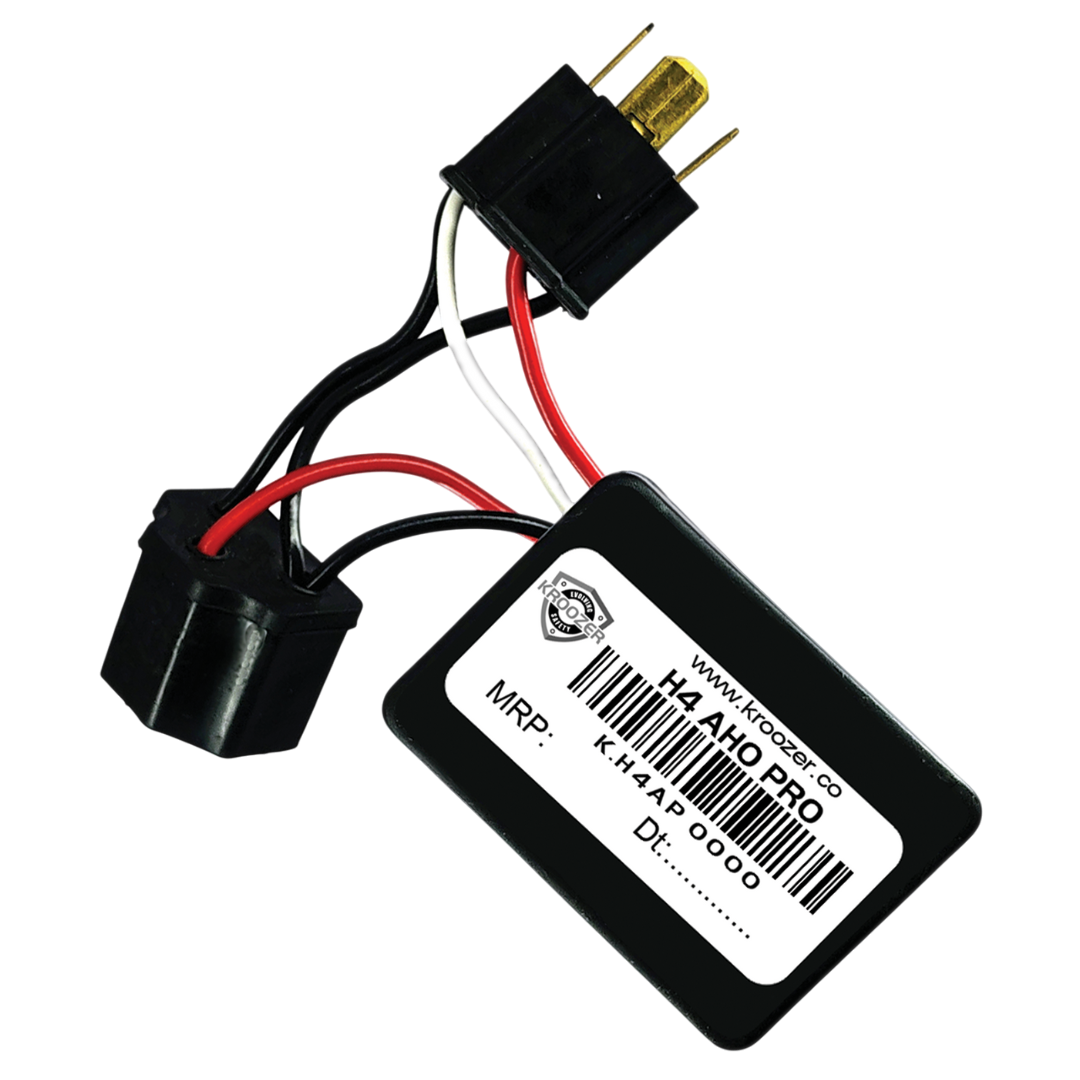
There are two fixes. The better one is an electronic flasher relay made for LED indicators, which times the blink itself instead of reading the circuit. The other is load resistors, which make the circuit look to the old unit the way filament bulbs did. Order the relay with the lights rather than a week later, and get one with the correct plug for your bike.
One side dead, in fault order
If only one side has stopped, work down this list and stop as soon as it lights.
- The bulb or LED module. Swap it with the one from the working side. If the fault travels with the part, you are done.
- The holder and its contacts. Open it up. Usually what you find is green or white powder on brass. Clean it back to bare metal.
- The earth. A poor earth produces odd behaviour rather than no behaviour: a dim lamp, blinking that changes when you touch the brake, one corner flickering while the other side is in use. Undo the earth screw, clean the paint and rust under it, tighten it back.
- The switch. Last, because it is least likely and dearest to replace.
If what has died is at the back rather than the corner, the order differs, and it is laid out in our guide to the one rear lamp doing three jobs.
Three checks if you are buying new indicators
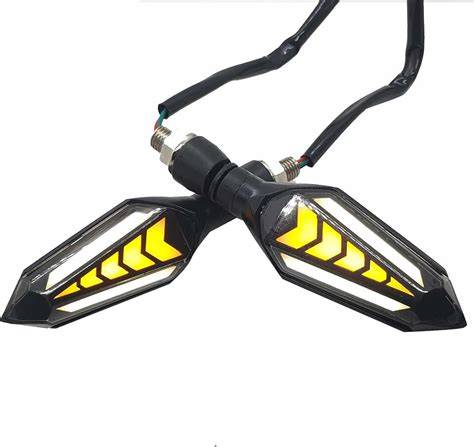
- Whether it can be seen from the side. Thin flush blinkers photograph beautifully and vanish the moment you are viewed from an angle. The driver who most needs your indicator is easing out of a side road, seeing you at roughly 45 degrees, not sitting directly behind you.
- The mount, not the lens. A flexible stem survives the parking tip over that snaps a rigid one, and in city use that tip over is a question of when.
- The plug, and the relay with it. Check the connector suits your bike, then budget for the flasher relay in the same purchase. A ₹250 set of LED blinkers that needs a relay you had not planned for was never a ₹250 upgrade.
On sequential blinkers, the flowing kind: the animation is for you, not the driver. What reaches him at the junction is amber, appearing and disappearing, on one side of your bike. Buy them because you like them, and expect the pattern to do no work.
What a blinker cannot do for you
An indicator only works on a driver who has already noticed you. It is a message to one person about one manoeuvre, and it arrives second. Being noticed in the first place is a separate job, done by a different kind of light, and no blinker upgrade touches it. Four unrelated parts are sold in India under the single word flasher, untangled in the four parts that share that one name. Hazards are a fifth case, in what hazard lights are for, and when they work against you.
Where a strobe sits next to your indicators
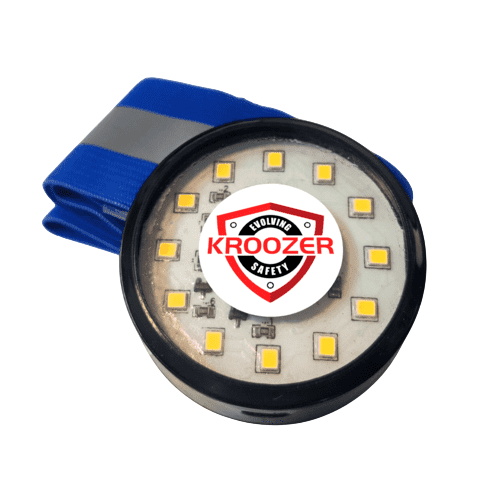
We build this part, so weigh it accordingly. The KROOZER STROBE V7.0 Pro with Brake Mode is not a replacement for your indicators and does nothing about signalling a turn. It answers the earlier problem: being registered at all. One pod per side, roughly 40 cm apart, so what reaches a windscreen is a width rather than a dot. It bolts on with an L bracket, no drilling, and most people finish fitting in 15 to 20 minutes. Twenty selectable patterns sit on a push button switch, and Brake Mode wires into the brake circuit so the pods fire when you brake, putting a change at the back of the bike at the moment one is worth most. Anodised aluminium housing, universal fitment across motorcycles, supplied as a pair at ₹1,399 with a one year warranty, made in India. Free shipping across India on orders over ₹1,000; from outside India we quote the shipping and confirm it before dispatch. The rest of the range sits on our strobe lights page.
One honest caution, because more light is not automatically better light. A badly chosen pattern reads as noise, so what a flash does well and what it cannot do is worth reading first. On the rules, Kroozer strobes are auxiliary visibility lights, and what you may run depends on your state and on how you use the light, so read our note on the rules for blinking lights in India and check your local RTO guidance. The point is to be seen, not to dazzle anybody.
What to do, in order
Cancel the blinker with your thumb on your next ride, and the one after, until you stop thinking about it. If a corner has died, start at the bulb and finish at the switch. If you are going LED, order the relay alongside the lights. And if your real worry is the car that pulls out as though you were not there at all, that is not an indicator fault, and no brighter blinker will fix it.


